
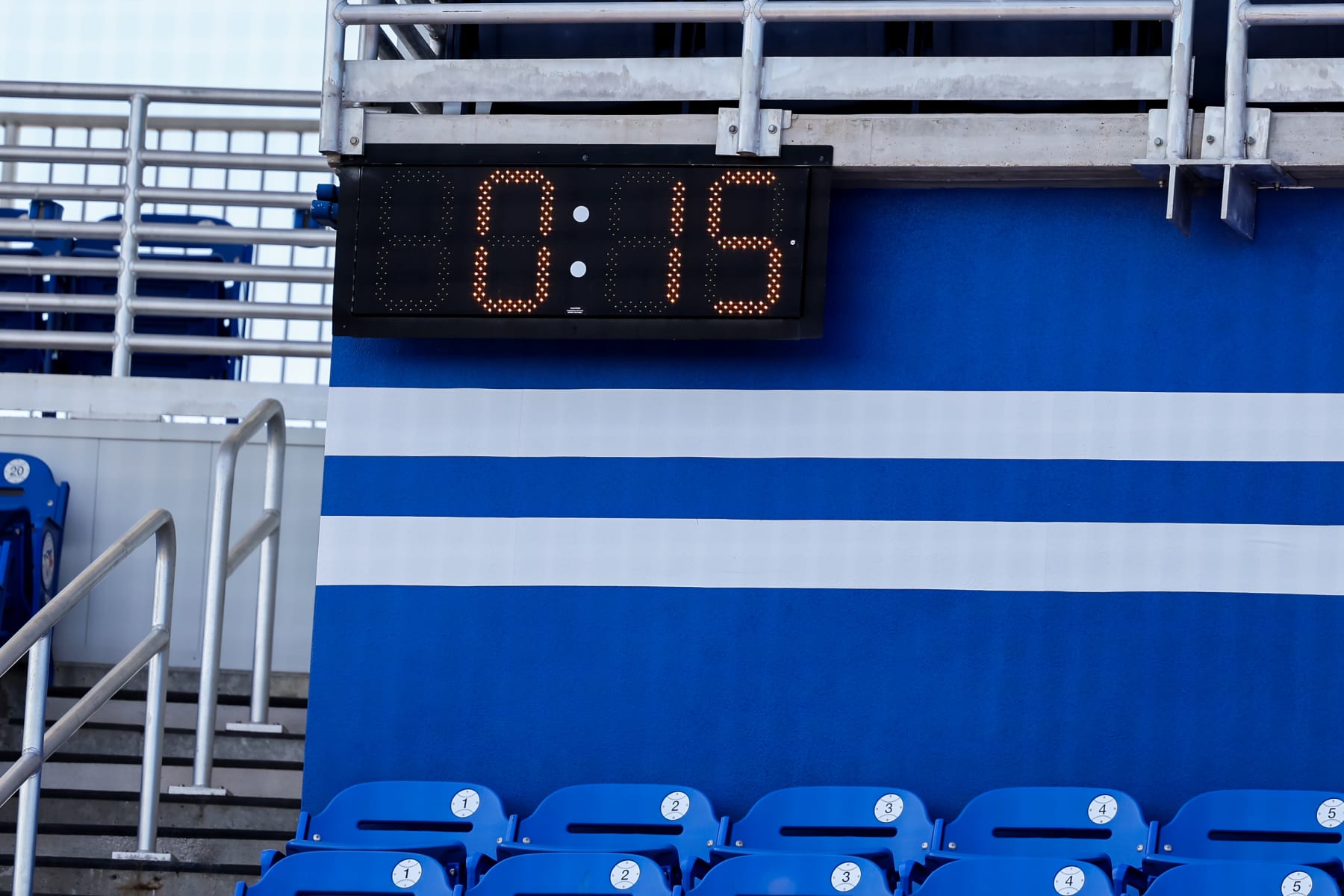
Yes, MLB playoff games use the pitch clock. The current limits are 15 seconds with the bases empty and 18 seconds with a runner on base. A batter must be in the box and alert to the pitcher when eight seconds remain. October does not give either player an unlimited pause between pitches.
The useful question while watching is what a particular call changes: an automatic ball, an automatic strike, or a runner advancing after a disengagement violation. This guide explains those situations using the current rules as reviewed October 10, 2026, with simple count examples you can follow alongside a playoff broadcast.
The current pitch clock limits apply in the playoffs
Keep three numbers in mind: 15, 18 and eight. MLB's current pace-of-play explanation sets the pitcher timer at 15 seconds with nobody on base and 18 seconds when there is a runner. The extra three seconds depend on the bases, rather than the inning, score or importance of the game.
| Situation | Clock requirement | What to watch |
|---|---|---|
| Bases empty | 15 seconds | The pitcher beginning the delivery |
| One or more runners on base | 18 seconds | The same delivery deadline, with more time available |
| Batter getting ready | Eight seconds remaining | The batter in the box and alert to the pitcher |
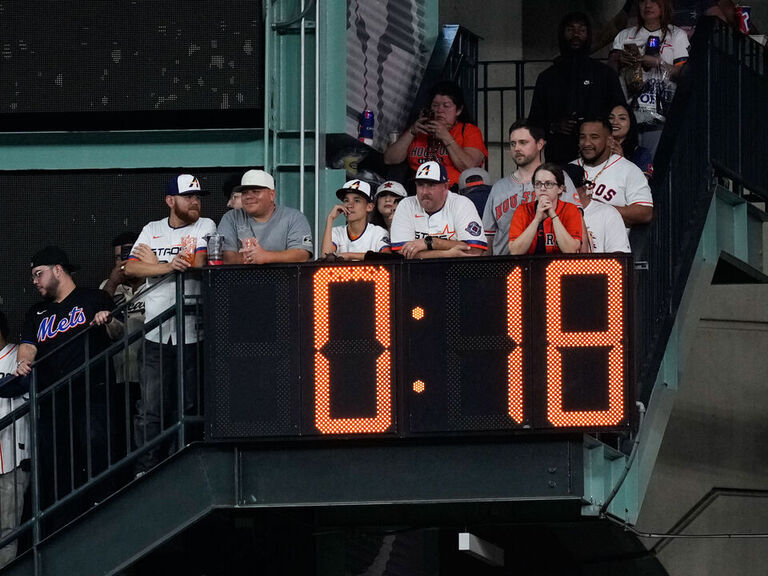
There is also a 30-second timer between batters; inning breaks use separate timing. The 15/18-second limits in the table apply between pitches.
An older explanation may say 20 seconds with runners aboard. MLB's 2024 rule modification reduced that number to 18. A page describing the original 2023 rollout can therefore explain the idea correctly while giving you an outdated number.
Pitchers must begin their delivery in time
The deadline concerns when the pitcher starts the pitching motion. It does not require the ball to reach the catcher before the display hits zero. That distinction matters when a replay freezes on a zero just as the baseball travels toward home plate: the relevant motion could have started earlier.
A quick glance at the display after a pitch is therefore insufficient to judge a violation. Follow the umpire's call and, if a replay is shown, look back to the start of the delivery. The speed of the pitch and the distance it travels are separate from the countdown requirement.
Batters must be ready at the eight-second mark
Eight seconds means time remaining. It does not mean eight seconds have elapsed after the timer starts. MLB's pitch timer explanation identifies the batter's readiness deadline, including being alert to the pitcher.
For a simple countdown example, an 18-second timer reaches eight after ten seconds; a 15-second timer reaches eight after seven. Those calculations explain why the initial countdown can differ while the batter's displayed deadline stays the same. They do not create a different batting rule for each base situation.
The MLB playoff format guide explains how October series work. The timer operates within those games; advancing from a short series to a longer one does not remove the countdown.
What a violation changes on the scoreboard
First identify which player was penalized. The basic distinction in MLB's official timer FAQ is simple: a pitcher violation adds a ball; a batter violation adds a strike. The count can change even though you have not seen a pitch travel through the strike zone.
That is why the count before the call is essential. An early-count penalty may only change the next pitching decision. The same penalty late in a plate appearance can put a batter on base or send him back to the dugout. These examples are hypothetical situations, rather than claims about a particular playoff game.
A pitcher violation adds a ball
At 1-1, an automatic ball produces a 2-1 count. The hitter is still batting, but the pitcher now has one less ball available before a walk. At 3-1, an automatic ball is ball four, so the batter receives first base. MLB's walk definition explains that four-ball outcome.
The base situation then determines who else must move. Picture the bases loaded with the score tied. Awarding first base to the batter forces the runner on first to second, the runner on second to third and the runner on third home. A run can therefore score without a batted ball. Picture a runner on second with first base open instead: awarding the batter first does not, by itself, force that runner off second.
| Count before the call | Penalty | Immediate result |
|---|---|---|
| 1-1 | Automatic ball | 2-1 |
| 3-1 | Automatic ball | Walk |
| 1-1 | Automatic strike | 1-2 |
| 2-2 | Automatic strike | Strikeout |
A batter violation adds a strike
At 1-1, an automatic strike makes the count 1-2. At 2-2, it supplies strike three and retires the batter. There is no foul-ball extension simply because the hitter did not swing: this is an assessed strike, not a ball that was hit foul.
With two outs, that strikeout also ends the half-inning. With fewer than two outs, the next hitter comes up and the inning continues. The number of outs is therefore just as useful as the count when you are trying to understand a sudden commercial break or a new batter appearing.
If you have switched broadcasts or joined late, use the matchup and inning on MLB games today to orient yourself, then follow the game's play-by-play for the specific call. A score alone will not explain whether a count changed because of a thrown pitch or a timer penalty.
How pickoffs and step-offs affect the timer
A disengagement is a pitcher stepping off the rubber or making a pickoff attempt. With a runner aboard, this can reset the timer. MLB limits the ordinary allowance to two disengagements per plate appearance, as described in its disengagement explanation.
Counting only throws to first base can mislead you. A step-off matters too, even when the pitcher keeps the ball in his hand. For a hypothetical example, a pitcher first steps off without throwing, then later throws to first with the runner returning safely. That has used two disengagements, despite only one throw going to the first baseman.
A third attempt is not simply forbidden in every circumstance. MLB's official rules demonstration explains the successful-pickoff exception. If the pitcher records the out, the third attempt is successful. If he makes the third attempt, no out is recorded and no runner advances, the disengagement violation results in a balk and runner advancement.
These are different outcomes from merely allowing the pitching countdown to expire. A pitcher timer violation adds a ball to the hitter's count; a disengagement violation concerns the runners. When an announcer says the pitcher has used his second disengagement, watch for the next move toward the base as well as the countdown toward home plate.
The two-disengagement limit has a runner-advance reset
The allowance resets when a runner advances during that plate appearance. Suppose a runner is on first and the pitcher has used two disengagements. The runner then steals second on a pitch. That advance renews the disengagement allowance. The count on the batter still reflects the pitch and any assessed calls; it is not reset to 0-0 because the runner changed bases.
Compare that with a pitch on which the runner stays at first. Throwing another ordinary pitch does not itself renew the disengagement allowance. There are two things to track: the ball-and-strike count for the hitter and the number of disengagements available while that hitter is still at the plate.
Nor does a pitcher's second disengagement guarantee a successful steal. The runner can still be caught on a pitch, and a successful subsequent pickoff remains possible. A bigger lead might be a tactical choice, but it is not proof that the defense has lost every way to record an out.
If the broadcast shows a disengagement indicator, treat it as an aid to following that sequence. Notice whether the runner actually advanced before assuming the earlier total still applies. This makes a late-inning pickoff decision easier to understand without trying to reconstruct the entire inning from memory.
When players can ask for time
A batter has one ordinary timeout per plate appearance. MLB's original rule summary states that allowance; its historical 20-second pitcher limit has since changed. Think of the timeout as something the hitter can use during this trip to the plate, rather than a fresh opportunity before every pitch.
Imagine a hitter asking for time early in a plate appearance and later finding himself with two strikes. The earlier timeout matters even if several pitches have followed. A lengthy plate appearance does not make it safe to assume the hitter still has that ordinary timeout available. Listen for the broadcast explaining whether it has already been used.
The request also has to be timely. In MLB's April 15, 2026 account, Alonso struck out after requesting time at eight seconds rather than by nine. Treat the readiness deadline as a deadline for being ready, not as an invitation to start asking for a pause.
For a viewer, the important distinction is between asking for time and the umpire granting it. A clip that shows a hand raised can explain what the hitter wanted, but follow the umpire's response to see what was actually allowed. The readiness obligation should not be treated as suspended solely because a player gestures.
Authorized pauses are another matter. MLB's implementation clarification allows additional time for specified circumstances such as a brushback or dislodged equipment. A legitimate interruption can therefore produce a stopped or reset timer without an automatic penalty.
When play pauses, look for the reason before drawing a conclusion. A player receiving attention and a hitter simply wanting longer to settle into the box are different viewing situations. The broadcast explanation and the umpire's handling of the restart are more useful than treating every pause as proof that the rule has been abandoned.
This also helps when a replay cuts between close-ups. A shot of the clock, then a shot of the player, may omit the moment when time was granted. If that moment is missing, leave the specific call open until you see the wider sequence or hear the explanation.
Extra innings and ABS challenges are separate questions
A playoff game can continue beyond nine innings while still using the pitch timer. The clock governs the pace between pitches; it is not a total time limit for the game. Reaching the tenth inning does not create an untimed version of baseball.
There is one especially visible postseason difference: no automatic runner begins the extra inning on second base. MLB's current postseason explanation confirms that rule. For the between-pitch timer, empty bases mean 15 seconds. Once a hitter reaches base and there is a runner aboard, the applicable between-pitch limit is 18 seconds.
For a hypothetical tenth inning, picture the first hitter walking. The next hitter now faces a pitcher working with a runner on base. The change from an empty base diamond to an occupied one explains the different timer setting. It is not extra time granted simply because the game went into extras.
A ball-strike challenge does not challenge the clock
The Automated Ball-Strike Challenge System, or ABS, is also used in the 2026 postseason. It checks a pitched ball's location against the strike zone. The official ABS documentation defines a challenge opportunity around a called pitch, with no swing, and an available challenge.
A timer penalty asks a different question: was the required action completed by its deadline? If a batter receives an automatic strike without a pitch being thrown, there is no pitch location for ABS to compare with the zone. The word automatic in the penalty does not turn it into an ABS review.
Compare two fictional moments at 1-2. In the first, a pitch is thrown, the hitter takes it and the umpire calls strike three; a permitted ABS challenge concerns that pitch's location. In the second, the hitter is penalized before a pitch is delivered. A strike-zone animation cannot answer whether he was alert in time.
Our MLB ABS challenge guide covers that separate process. During a timer dispute, listen for an explanation about timing or readiness; during an ABS challenge, watch the pitch-location result. Both can affect the count, but they evaluate different events.
Watch the call as well as the countdown
A timer graphic makes a complicated moment look simple, but it is only one part of the sequence. The useful viewing habit is to connect the clock with the player's action, the umpire's decision and the resulting count or base movement.
- Check the bases. An empty or occupied base diamond tells you which between-pitch limit applies.
- Note the old count. That lets you recognize whether an assessed ball or strike completes the plate appearance.
- Watch the relevant action. For the pitcher, look for the beginning of the delivery; for the hitter, look for readiness or granted time.
- Follow the call. Notice whether the outcome is a count change, an out, a walk, a runner advancing or simply an authorized restart.
A phone stopwatch measuring one pitch release to the next measures something different. Baseball Savant's pitch tempo explanation specifically distinguishes release-to-release timing from the pitch timer. The ball traveling to the catcher and returning to the pitcher takes time too; adding that time into your own interval does not prove that the pitcher exceeded his allotted countdown.
For a disputed moment, try to see what happened before the close-up. Did a runner advance? Had the hitter already used a timeout? Did the umpire grant an interruption? Those questions can supply the context that a still image of the display leaves out.
The full-game replay guide can help you find a longer sequence when the short highlight ends too soon. Choose the plate appearance and watch the lead-up as well as the call. A replay is useful for understanding events; it does not make every missing camera angle available.
You can follow the consequence even when the precise timing is hard to see. Read the new count, outs and bases after the umpire has handled the situation. That tells you what the teams must do next, whether the next moment is another pitch, a new batter or a change of innings.
Loading comments...