

The current MLB playoff format sends 12 teams to the postseason—six from the American League and six from the National League. Each league qualifies three division winners and three Wild Card clubs. The top two division winners receive first-round byes, while seeds No. 3 through No. 6 play best-of-three Wild Card Series.
From there, each league follows a fixed bracket. The No. 1 seed awaits the winner of the 4-vs.-5 matchup, and the No. 2 seed awaits the winner of 3 vs. 6. MLB does not reseed after the Wild Card round. The winners of the AL and NL brackets eventually meet in the World Series.
This guide explains that path from qualification through the championship round. For more October coverage, browse the site's MLB postseason guides.
MLB playoff format at a glance
The two leagues use the same six-seed structure. Think of the AL and NL as parallel tournaments that remain separate until the World Series.
| Seed or stage | How it is earned | First postseason assignment |
|---|---|---|
| No. 1 seed | Division winner with the league's best record | Bye; faces the 4/5 winner in the Division Series |
| No. 2 seed | Division winner with the second-best record | Bye; faces the 3/6 winner in the Division Series |
| No. 3 seed | Remaining division winner | Hosts No. 6 in a best-of-three Wild Card Series |
| No. 4 seed | Wild Card club with the best record | Hosts No. 5 in a best-of-three Wild Card Series |
| No. 5 seed | Wild Card club with the second-best record | Visits No. 4 in the Wild Card Series |
| No. 6 seed | Wild Card club with the third-best record | Visits No. 3 in the Wild Card Series |
Once the Wild Card Series ends, the postseason moves through a best-of-five Division Series, a best-of-seven League Championship Series and a best-of-seven World Series. If your question is how many games a club could play along the way, the site's guide to MLB regular-season and playoff game totals shows the full arithmetic.
How teams qualify for the MLB playoffs
MLB has six divisions: East, Central and West in each league. The club with the best regular-season record in each division qualifies as a division winner. That accounts for three postseason teams in the AL and three in the NL.
After removing those division winners, the three clubs with the best remaining records in each league earn Wild Card berths. A Wild Card is not a random selection or a play-in invitation. It is a postseason place earned through the regular-season standings without winning a division.
Division status matters when MLB builds the bracket. The three division winners are assigned seeds 1 through 3, and the three Wild Card clubs receive seeds 4 through 6. That priority remains even if a Wild Card club finishes with a better record than one of the division winners. The better Wild Card record can earn seed No. 4 and a home Wild Card Series, but it cannot become seed No. 3.
Qualification is not final until the regular season is complete and any ties are resolved. You can use the complete MLB schedule to follow the remaining calendar, while the site's guide to the end of the 2026 regular season explains when the standings stop changing.
How MLB playoff seeds 1 through 6 work
A seed is more than a ranking beside a team's name. It determines whether the club must play in the opening round, whether it hosts that round and which side of the league bracket it occupies.
- No. 1: the division winner with the best record in its league.
- No. 2: the division winner with the second-best record.
- No. 3: the third division winner, regardless of whether a Wild Card club has a better record.
- No. 4: the non-division winner with the best record.
- No. 5: the non-division winner with the next-best record.
- No. 6: the final Wild Card qualifier.
The same ordering is performed independently in the AL and NL. There is no combined 1-through-12 ranking across all of MLB.
Why the top two seeds receive byes
Seeds No. 1 and No. 2 advance directly to the Division Series. This rewards the two strongest division winners in each league and keeps the opening round compact. They avoid a short series in which two losses would end the season and can prepare their pitching staff for the next round.
The bye also creates a meaningful race between division leaders. A club may have its division largely under control but still be competing for one of the league's top two records. Moving from seed No. 3 to No. 2 changes the path from hosting a Wild Card Series to skipping it entirely. Check today's MLB games when those late-season races tighten.
How the Wild Card Series works
Four clubs in each league begin in the Wild Card round. Seed No. 3 plays No. 6, while No. 4 plays No. 5. Each matchup is best-of-three, so the first club to win two games advances and the losing club is eliminated.
Every game in a Wild Card Series is played at the higher seed's park. No. 3 hosts the entire series against No. 6, and No. 4 hosts the entire series against No. 5. Even if the matchup reaches a third game, the lower seed does not receive a home date.
This is different from the old single-elimination Wild Card Game. MLB replaced that one-game round with the current best-of-three series when the postseason expanded to 12 teams in 2022. The three-day setup gives the lower seed more than one chance to survive while limiting the wait for the four clubs that earned byes.
The MLB bracket is fixed: there is no reseeding
The most important bracket rule is easy to miss: MLB does not reorder the teams after the Wild Card Series. Each opening-round matchup already has a fixed destination:
- The winner of No. 4 vs. No. 5 advances to face seed No. 1.
- The winner of No. 3 vs. No. 6 advances to face seed No. 2.
Suppose No. 6 upsets No. 3 and No. 4 defeats No. 5. No. 6 is now the lowest remaining seed, but it does not move across the bracket to play No. 1. It stays on its original path and meets No. 2. Seed No. 1 still plays the winner from the 4/5 side.
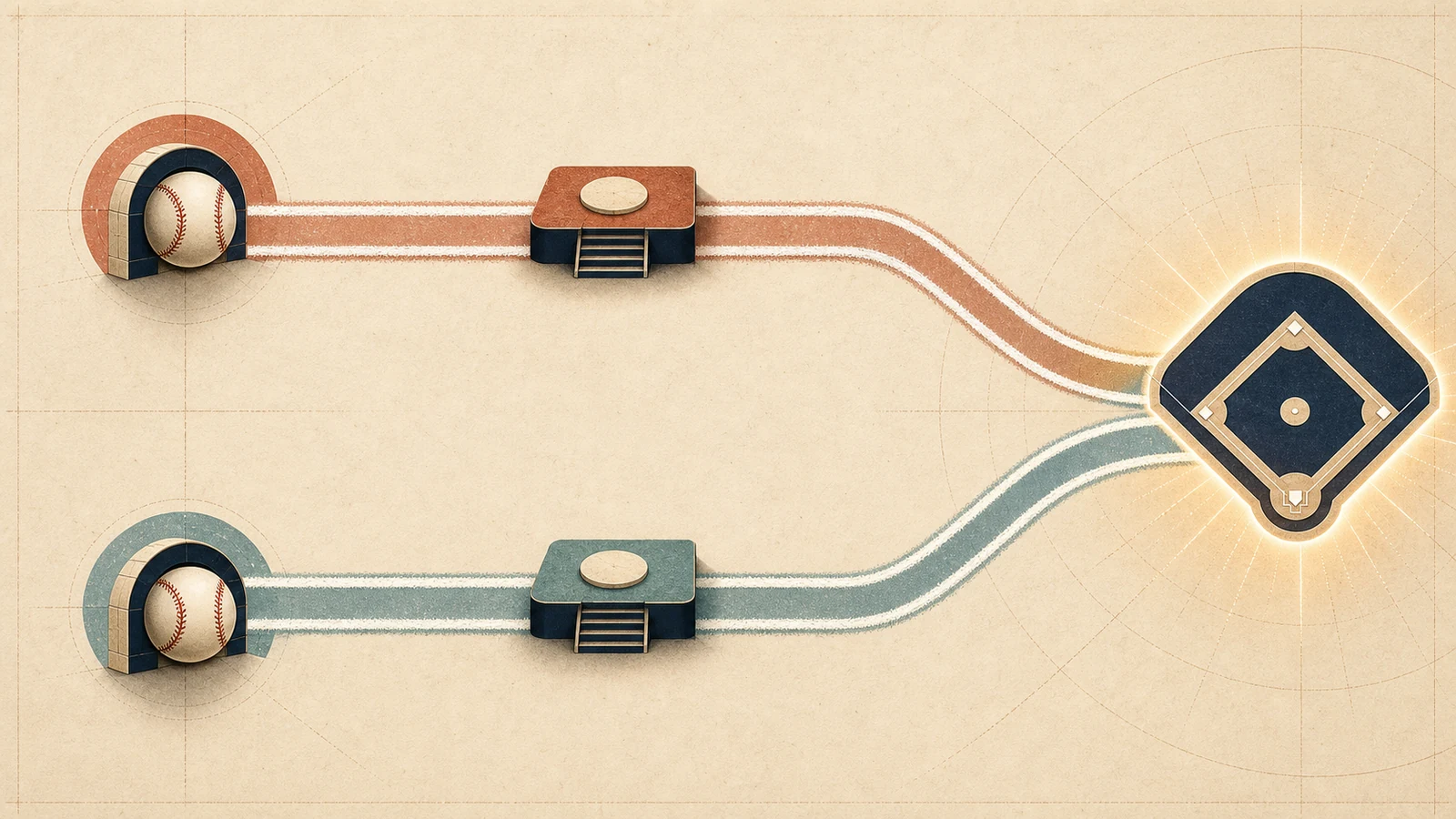
This fixed structure lets fans identify a team's possible Division Series opponent as soon as the six seeds are set. An upset changes the club on that path, not the path itself.
Round-by-round path to the World Series
A team that starts in the Wild Card Series must advance through four rounds to win the championship. A top-two seed starts one step later, but every remaining club follows the same league bracket from the Division Series onward.
Division Series
Four clubs remain in each league for the Division Series. Seed No. 1 plays the 4/5 winner, and No. 2 plays the 3/6 winner. Each series is best-of-five, so the first team to three wins advances.
The higher seed has home-field advantage in a 2-2-1 arrangement: it hosts Games 1 and 2, the lower seed hosts Games 3 and 4 if needed, and the higher seed hosts a possible Game 5. The two winners move to their league's championship round.
League Championship Series
The American League Championship Series and National League Championship Series are best-of-seven. The first club to win four games claims its league pennant and advances to the World Series. Home-field advantage belongs to the higher seed.
At this stage, the two league brackets are still separate. An AL club cannot face an NL club until both have won their respective championship series.
World Series
The AL champion and NL champion meet in a best-of-seven World Series. The first team to four victories is the MLB champion.
World Series home field is not awarded simply by comparing the clubs' original seed numbers, because those numbers came from separate leagues. Instead, the pennant winner with the better regular-season record receives home-field advantage. If the records are identical, MLB applies its postseason tiebreaker procedure.
How home-field advantage works in each round
The phrase “higher seed hosts” does not mean the same site pattern in every round. The practical differences are:
| Round | Home-field rule | What fans should remember |
|---|---|---|
| Wild Card Series | Higher seed hosts every game | The lower seed receives no home game |
| Division Series | Higher seed has a 2-2-1 arrangement | Games 1, 2 and a possible Game 5 are at the higher seed |
| League Championship Series | Higher seed has home-field advantage | The series can last up to seven games |
| World Series | Better regular-season record gets home field | Original AL and NL seed numbers are not compared directly |
Home field is valuable, but it does not erase the bracket. A lower seed that wins on the road advances along the same fixed route established on seeding day.
How MLB playoff tiebreakers work
There is no longer a winner-take-all Game 163 to settle a division title or the final Wild Card berth. MLB uses results already produced during the regular season to determine qualification and seeding, allowing the Wild Card Series to begin without an extra play-in date.
For a tie between two clubs, the first test is head-to-head record. If that does not resolve the tie, MLB moves to intradivision record, then intraleague record, then record in the last half of intraleague games. If necessary, the process adds the preceding intraleague game one at a time until the tie breaks.
Three- and four-team ties require additional comparisons among the tied clubs before the same division and league layers are applied. Because the order can change as teams are assigned to different available spots, fans should use MLB's official postseason tiebreaker explanation for a live multi-team scenario rather than relying on run differential or an unofficial calculator.
How to read the playoff race before the bracket is set
Before the regular season ends, the bracket is a projection rather than a final matchup list. Follow three separate races in each league:
- Division leads: identify the current winners of the East, Central and West.
- Bye positions: compare the records of those three division leaders; the top two occupy seeds No. 1 and No. 2.
- Wild Card positions: remove the division leaders, then rank the three best remaining clubs as seeds No. 4, No. 5 and No. 6.
That method prevents a common mistake: ranking the six projected qualifiers only by wins. Division winners must be placed first, even when a Wild Card contender has a stronger record than the third division leader. Because the occupants can change daily, use live standings alongside the schedule instead of treating an old screenshot as the current bracket.
Frequently asked questions
How many teams make the MLB playoffs?
Twelve teams qualify: six from the American League and six from the National League. Each league contributes three division winners and three Wild Card clubs.
How many Wild Card teams make the MLB playoffs?
Six Wild Card teams qualify across MLB—three per league. The top Wild Card is seed No. 4, the second is No. 5 and the third is No. 6.
Does MLB reseed after the Wild Card Series?
No. The bracket is fixed. The 4/5 winner plays No. 1, and the 3/6 winner plays No. 2, even if seed No. 6 becomes the lowest remaining club.
Can a Wild Card team have a better record than a division winner?
Yes. It can finish with more wins than the third division winner, but division winners still receive seeds 1 through 3. The Wild Card club can be seeded no higher than No. 4.
Is there still a Game 163?
No. MLB now resolves ties affecting playoff qualification and seeding with mathematical tiebreakers, beginning with head-to-head results, instead of scheduling an extra regular-season game.
Bottom line: remember the fixed map in each league—two division winners get byes, No. 3 hosts No. 6, No. 4 hosts No. 5, the 4/5 winner goes to No. 1 and the 3/6 winner goes to No. 2. Once that map is clear, the rest of the MLB playoff bracket is straightforward.
Loading comments...