

An MLB team is scheduled to play 162 regular-season games. If it reaches the postseason, it can play anywhere from two to 22 more, depending on its seed, how far it advances and how long each series lasts. A World Series champion plays 11 to 22 postseason games, so its combined regular-season and playoff total can range from 173 to 184.
Leaguewide, MLB schedules 2,430 unique regular-season games. Under the current 12-team postseason format, October adds between 32 and 53 games. That puts the full regular season plus postseason at 2,462 to 2,483 games. The range exists because a best-of-five or best-of-seven series ends as soon as one team earns the required number of wins.
The quick answer in one table
| What is being counted? | Number of games | What the number means |
|---|---|---|
| One team's regular season | 162 | The standard schedule for every club |
| Entire MLB regular season | 2,430 | Unique games across all 30 clubs |
| One postseason qualifier | 2-22 | Additional games; the path depends on seed and results |
| World Series champion | 11-22 | Additional postseason games |
| Entire MLB postseason | 32-53 | Unique games under the current format |
| Regular season plus postseason | 2,462-2,483 | Leaguewide scheduled/possible range |
Those figures count games, not team appearances. They also exclude Spring Training and the All-Star Game. The sections below show exactly where every number comes from.
Why every MLB team is scheduled for 162 regular-season games
The modern standard is 162 games per club: 81 at home and 81 on the road. MLB's balanced schedule also means every team meets each of the other 29 clubs during the season. Division rivals appear more often, while most Interleague opponents meet for one series.
The word scheduled matters. A late postponement that has no bearing on the standings may not always be made up, and extraordinary events such as a labor stoppage can shorten a season. But 162 is the normal full-season target and the number used to compare team records.
You can browse the complete MLB schedule by date or add the full schedule calendar to a compatible calendar app. Those tools show the individual matchups behind the 162-game total.
Why the leaguewide regular-season total is 2,430, not 4,860
Multiplying 30 teams by 162 produces 4,860 team-games. That is not the number of contests, because both the home team and the road team appear once in that multiplication. Divide by the two participants in every matchup:
30 teams × 162 games ÷ 2 teams per game = 2,430 unique games.
Think of a Yankees–Red Sox game as one entry on the league calendar but one game played for New York and one game played for Boston. Adding every club's schedule counts that same contest twice, so the division by two is essential.
How many games are in each MLB playoff round?
MLB's current postseason format sends 12 teams to the bracket, six from each league. The top two seeds in both the American League and National League receive a first-round bye. The other eight clubs play in four Wild Card Series.
| Round | Number of series | Format | Games per series |
|---|---|---|---|
| Wild Card Series | 4 | Best of 3 | 2-3 |
| Division Series | 4 | Best of 5 | 3-5 |
| League Championship Series | 2 | Best of 7 | 4-7 |
| World Series | 1 | Best of 7 | 4-7 |
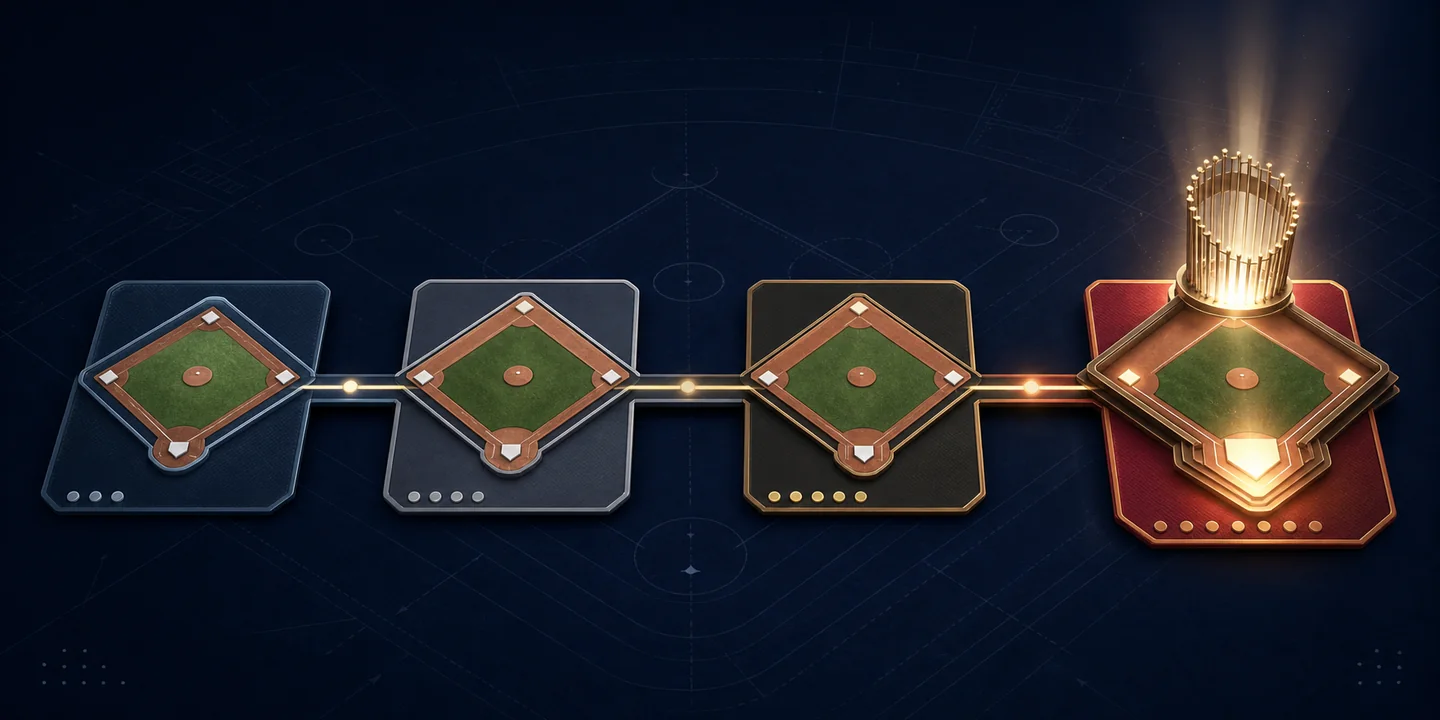
"Best of" describes the maximum length, not a mandatory number of games. A best-of-three ends when one club wins twice; a best-of-five ends at three wins; and a best-of-seven ends at four. The bracket is not reseeded after the Wild Card round. For more format and schedule coverage, see the site's postseason guides.
How many total games can one team play including the playoffs?
The answer depends first on whether the club receives a Wild Card bye, and then on whether it is eliminated or keeps advancing.
A team that starts in the Wild Card Series
A first-round participant that is swept plays only two postseason games, for 164 games overall after a completed regular season. If the series reaches Game 3 before elimination, the total is 165.
A champion coming through the Wild Card round plays at least 13 postseason games:
2 Wild Card + 3 Division Series + 4 LCS + 4 World Series = 13.
If all four series go the distance, the same champion plays 22 postseason games:
3 + 5 + 7 + 7 = 22.
That produces a championship-season range of 175 to 184 games for a club without a first-round bye.
A team with a first-round bye
A bye team begins in the Division Series. If it is swept there, it adds three games and finishes with 165 overall. If it wins the championship as quickly as possible, it plays 11 postseason games: three in the Division Series, four in the LCS and four in the World Series. Its minimum championship total is therefore 173.
The longest bye-team championship path is 19 postseason games, or 181 including the regular season. The absolute 184-game maximum is only available to a team that starts in the Wild Card Series and takes every round to its final possible game.
How many games are in the entire MLB season including playoffs?
To count the whole postseason, multiply the number of series in each round by the shortest or longest possible series length.
Minimum: 32 postseason games
If every series is a sweep, the calculation is:
(4 × 2) + (4 × 3) + (2 × 4) + 4 = 32 games.
Those terms represent four Wild Card Series, four Division Series, two League Championship Series and one World Series. Add the 2,430-game regular season and the minimum current-format total is 2,462 games.
Maximum: 53 postseason games
If every series reaches its deciding game, the calculation becomes:
(4 × 3) + (4 × 5) + (2 × 7) + 7 = 53 games.
Adding those 53 games to 2,430 yields a maximum of 2,483 games. A claim of 59 postseason games usually comes from mistakenly counting six Wild Card Series. The 12-team field has four first-round byes, leaving eight clubs to play in four—not six—Wild Card Series.
This 2,462-2,483 range describes the current format. It is not a forecast that every regular-season matchup will be completed or that every playoff series will reach the same length.
What is not included in the 162-game total?
- Spring Training: Cactus League and Grapefruit League games are exhibitions. Their results do not count toward regular-season standings.
- Spring Breakout and other exhibitions: These events sit outside the championship-season record as well.
- The All-Star Game and Home Run Derby: They are showcase events during the midseason break, not games on any club's 162-game record.
- The postseason: Wild Card, Division Series, LCS and World Series games are added after the regular season and recorded separately.
That distinction is useful when a schedule app displays exhibition and regular-season contests together. To see only the immediate calendar, check today's MLB games or preview tomorrow's matchups.
Why does MLB play 162 games?
The number grew out of league expansion, not a formula designed for today's 30-team structure. According to the National Baseball Hall of Fame, the eight-team American League used a 154-game schedule from 1904 through 1960. Each club faced its seven league opponents 22 times.
When the American League expanded to 10 teams in 1961, playing each of nine opponents 18 times produced 162 games. The National League expanded and adopted the same length in 1962. Divisions, Interleague play, realignment and the balanced schedule have all changed the opponent mix since then, but 162 has remained the full-season benchmark.
This history also explains why older single-season records sometimes come from 154-game schedules and why the shortened 2020 season looks so different in statistical comparisons. When evaluating a win total, hitting record or pitching workload, the schedule length is part of the context.
Frequently asked questions
Is 162 games for one team or all of MLB?
It is the standard regular-season schedule for one team. Across 30 clubs, that creates 4,860 team appearances but 2,430 actual games because two teams participate in every contest.
Can an MLB team play more than 162 games?
Yes, after including postseason games. Under the current format, a club can play as many as 184 combined regular-season and postseason games. The old winner-take-all Game 163 for tied teams is no longer used; MLB now resolves postseason qualification and seeding ties with mathematical tiebreakers.
A player's games-played statistic can also exceed 162 in an unusual case, such as appearing for one club before a trade and then joining a team at a different point in its schedule. That does not change either team's normal 162-game slate.
What is the maximum number of playoff games for one team?
Twenty-two. To reach that maximum, the team must begin in the Wild Card Series, advance to the World Series and take all four rounds to their maximum length: 3 + 5 + 7 + 7.
Does the World Series always last seven games?
No. "Best of seven" means the first team to four wins becomes champion. A sweep ends in four games; otherwise the series can finish in five, six or seven. Seven is the maximum, not the required length.
Bottom line: remember three numbers—162 games per club, 2,430 unique regular-season games across MLB and 32-53 more games in the current postseason. Everything else follows from whether you are counting one team, the champion's path or the league as a whole.
Loading comments...