
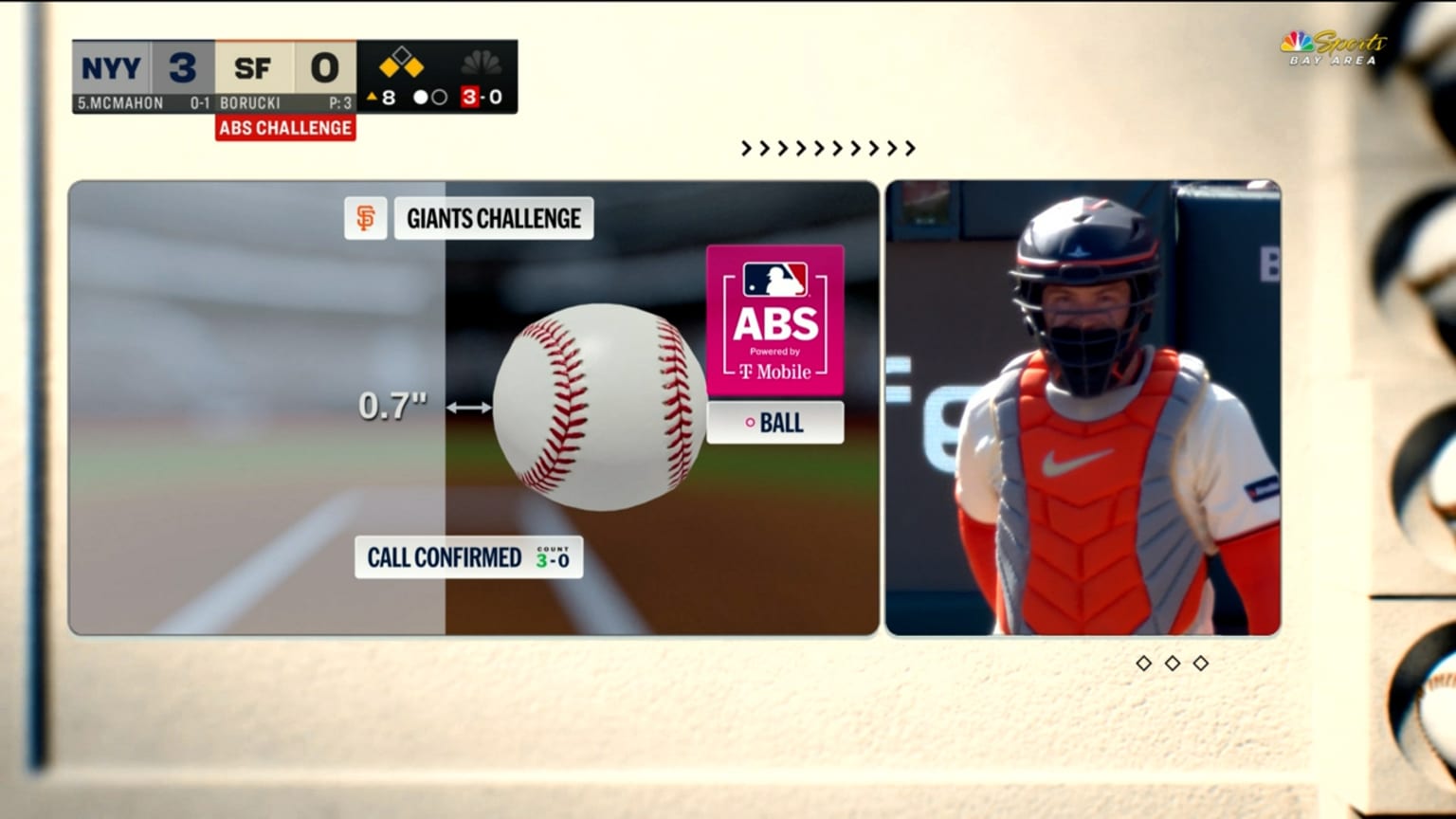
MLB's ABS Challenge System keeps the home-plate umpire in charge of calling every pitch, but gives players a limited way to ask tracking technology to review a ball or strike. It debuted throughout Major League Spring Training, the regular season and postseason in 2026. The result is not a fully automated “robot umpire”; it is a fast appeal system with tactical costs.
What Is the MLB ABS Challenge System?
ABS stands for Automated Ball-Strike. Cameras installed around the ballpark track a pitch as it reaches home plate, then software compares the ball's location with a standardized strike zone calculated for the batter. That technology does not announce every pitch. The plate umpire makes the live call exactly as before unless an eligible player immediately challenges it.
When a challenge occurs, the system determines whether the pitch touched the automated zone. The result is shown on the ballpark video board and on the broadcast, and the umpire announces the corrected or confirmed call. If the technology disagrees with the human call, the count—and any resulting strikeout, walk or continuation of the plate appearance—changes accordingly.
MLB introduced this hybrid format across Spring Training, the championship season and postseason in 2026 after years of testing in the Minor Leagues and a 2025 Major League trial. The choice preserves three things at once: the umpire's responsibility for the ordinary flow of the game, technology's ability to settle selected borderline pitches, and a strategic limit that prevents every call from becoming a review.
That makes ABS separate from the familiar replay system. A manager does not stroll out to request a ball-strike review, and a video-room specialist does not initiate it. Only specified players involved in the pitch can challenge. Checked swings, safe/out calls and boundary plays remain governed by their own rules. When watching today's MLB games, think of ABS as a narrow appeal attached to the previous called pitch—not a universal replay button.
The Complete ABS Challenge Rules
| Rule | How it works |
|---|---|
| Starting supply | Each club begins with two challenges. |
| Who can challenge | The batter, catcher or pitcher involved in the pitch. |
| Signal | The player taps the side of a helmet or cap immediately after the call. |
| Successful challenge | The call changes and the club retains that challenge. |
| Unsuccessful challenge | The original call stands and the club loses one challenge. |
| Extra innings | A club with no challenge remaining when extra innings begin receives one for the 10th. |
The “immediately” requirement is central. The eligible player must react before another action begins and cannot wait for a manager, bench coach or video-room employee to study a replay. Teammates cannot initiate the appeal on the player's behalf. That design turns body awareness and conviction into part of the play instead of importing the slower managerial replay process.
A challenge is successful when ABS changes the call. For example, if the umpire called strike three but the tracked pitch did not touch the automated zone, the call becomes a ball, the plate appearance continues and the team keeps its challenge. If the system says the pitch did touch the zone, strike three stands and one challenge is charged.
The two challenges belong to the team, not to each player. A batter and catcher cannot each possess a private allotment. Because successful challenges are retained, a club can use more than two reviews in a game if it keeps being right. Conversely, two failed appeals can leave the entire team without another regulation-inning challenge.
The extra-inning provision is a safeguard for leverage. If a club reaches the end of nine with no challenge left, it receives one for the 10th. This should not be confused with receiving two fresh challenges or resetting the entire game. The official scoring and umpire crew handle the corrected count; fantasy providers, broadcasts and game feeds may take a moment to reflect the change.
What Happens During an ABS Challenge?
- The plate umpire calls the pitch a ball or strike.
- An eligible batter, catcher or pitcher immediately taps a helmet or cap.
- The umpire recognizes and announces the challenge.
- ABS compares the tracked pitch with that batter's calibrated automated zone.
- The ballpark board and broadcast show whether the pitch touched the zone.
- The umpire applies the confirmed or overturned result and play resumes.
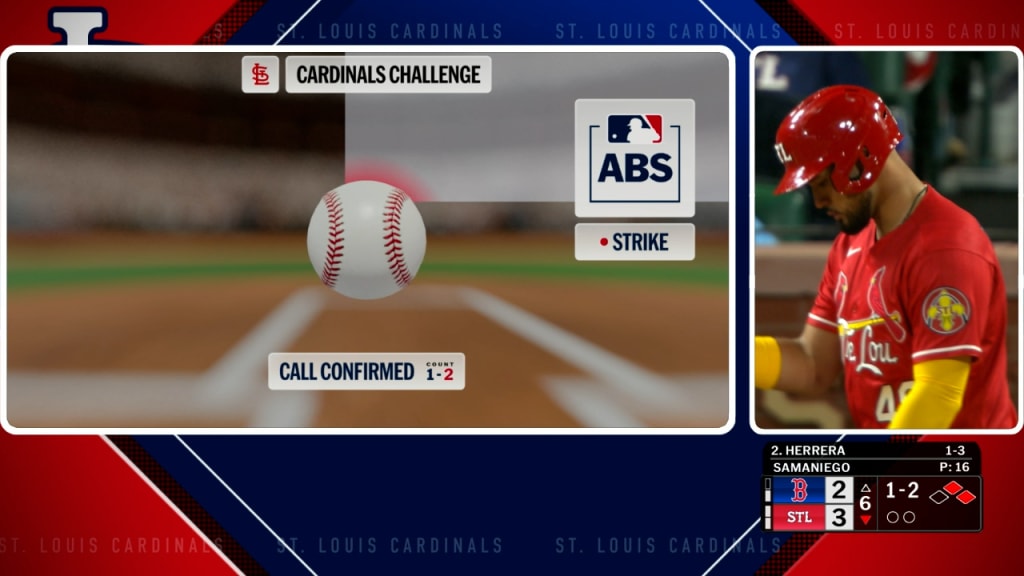
The display is intentionally easy to read. “Call confirmed” means the umpire's original ball or strike remains correct. “Call overturned” means ABS produced the opposite result. The animation can also show how far a miss was outside an edge, making a fraction-of-an-inch decision legible to a crowd without turning the stoppage into a long video review.
The first regular-season MLB challenge illustrated the ordinary case: Yankees batter José Caballero appealed a called strike on Opening Night, and the call was upheld. The first successful challenge showed the stakes more dramatically. Mets catcher Francisco Alvarez challenged a full-count ball, ABS found that the pitch clipped the zone, and the result became strike three instead of a walk.
Technology does have a fallback path. If the pitch is tracked but the public graphic fails, the ABS operator can relay the result to the plate umpire, who tells the clubs. If the pitch cannot be tracked, the original call stands and the team keeps its challenge. MLB can temporarily pause challenges when the system is not operating reliably.
After the decision, follow the adjusted count and play result through the official feed. Our MLB Gameday play-by-play guide explains how game events appear, but a brief data delay can occur while external score and fantasy services reconcile an overturned call.
How MLB Defines the Automated Strike Zone
The ABS zone is a two-dimensional rectangle positioned at the middle of home plate. Its horizontal edges match the 17-inch width of the plate. Its vertical boundaries change with each hitter: the top is set at 53.5% of the player's certified height and the bottom at 27%. If any part of the tracked baseball touches that rectangle, ABS judges the pitch a strike.
For a simple arithmetic example, a player certified at 72 inches would have a top boundary at 38.52 inches and a bottom boundary at 19.44 inches. That calculation illustrates the percentages; it should not be used to recreate a live call from a television screenshot. Camera angle, lens distortion and a broadcast's decorative zone can all differ from the calibrated tracking result.
MLB established a measurement process because a height-based zone creates an incentive to make a player appear shorter or taller. Position players are measured standing straight and without cleats, using manual measurement and biomechanical analysis to confirm the result. A certified height must exist before a player appears in a Major League game. The zone therefore follows official measurement, not the crouch a batter chooses on one particular pitch.
This geometry differs from the prose rulebook's traditional three-dimensional strike-zone concept. A pitch can move through space above the plate, while ABS makes its decision at a defined two-dimensional plane. That creates a crisp boundary for review, even though the umpire's unaided working zone has historically behaved more like a rounded shape.
Fans should also distinguish the official ABS graphic from the translucent box shown throughout many broadcasts. The live TV box is an explanatory overlay and may be delayed or calibrated differently; it does not grant a challenge and is not the authoritative decision. MLB deliberately delays certain live pitch-location data so a dugout cannot use a feed to help a player decide. The official challenge animation is the result that governs the call.
Challenge Strategy for Batters, Catchers and Pitchers
A challenge's value depends on both the chance of being right and the change in game state. Turning ball four into strike three ends a plate appearance instead of placing a runner on base. Turning strike three into ball four does the reverse. Those full-count calls are obvious leverage points, but an earlier pitch can also reshape what the hitter or pitcher can do next.
For batters
A hitter should combine location awareness with count and game situation. Called third strikes demand a quick decision because there is no future pitch in that plate appearance to save the appeal for. Tall hitters who often feel the top boundary is misjudged may develop a strong personal map, but reputation is not evidence on a specific pitch. Two emotional misses can spend the team's supply.
For catchers
The catcher sees glove location but also manages a shared resource for nine innings. A catcher may challenge a called ball to create a strikeout, avoid a walk or improve the count. Game plan matters: a receiver should know which pitchers reliably recognize a missed edge and how the dugout wants to prioritize late leverage, even though the dugout cannot signal the appeal after the pitch.
For pitchers
A pitcher can act when body feel and intended location create unusual certainty. Yet the catcher's view may be better on a pitch moving across an edge. Clubs therefore need pregame communication: who takes responsibility if both battery members react, which counts justify aggression and how much trust a particular pitcher or catcher has earned from results.
Early MLB analysis estimated a successful challenge as worth roughly 0.2 runs on average, while emphasizing that context changes the value. That does not mean every close pitch deserves an appeal. A challenge that converts a 1-0 count to 0-1 in a low-leverage inning is useful, but it may not justify the same risk as a ninth-inning full count.
The best strategy avoids both extremes. Spending appeals merely because the screen looked close can exhaust them. Hoarding both until the game ends wastes a correction opportunity. Teams should combine player-specific accuracy, count leverage, inning, baserunners and remaining supply—then let the eligible player make the immediate call.
What 2026 ABS Results Can and Cannot Tell Us
The official Baseball Savant ABS dashboard provides the cleanest current snapshot. Through the site's update checked on September 3, 2026, MLB players had initiated 8,958 challenges: 4,810 calls were overturned and 4,148 were confirmed. That is a 54% overall overturn rate. Batters were at 49%, while fielders—mostly catchers, with some pitchers—were at 58%.
Those totals show that appeals are selective, not random. Players challenge pitches they believe were missed, so an overturn rate above the underlying umpire error rate is expected. The number does not mean umpires are wrong on 54% of all balls and strikes. It means ABS disagreed on 54% of pitches that an eligible player chose to challenge while a team had an appeal available.
Raw success percentage also needs opportunity context. A player who wins one of one is technically at 100%, but that single pitch does not prove an elite skill. Another player may challenge many difficult, high-value calls and finish near 50%. Baseball Savant therefore offers detailed measures, including challenge opportunities, challenge rate and performance relative to the expected likelihood of an overturn.
The batter/fielder split does not establish that catchers permanently have better eyes. Their vantage points, pitch expectations and the direction of the disputed call differ. A batter challenges a called strike he believes missed. A fielder challenges a called ball he believes caught the zone. The populations of pitches and game decisions are not identical.
Use the dashboard as a living record rather than freeze a September leader into an evergreen claim. Sort by role, set a meaningful minimum number of challenges, inspect both volume and rate, and note the date. For additional ways to follow official baseball data on a phone, see our guide to the best MLB apps in 2026. Season totals will continue moving until the schedule ends.
How ABS Changes Catching, Umpiring and the Broadcast
Catchers still receive thousands of unchallenged pitches
ABS does not erase catcher framing. Plate umpires continue calling nearly every pitch without review, and only a small fraction of eligible calls are challenged. A quiet glove, stable body and credible presentation can still affect the human call. What changes is the risk at a high-leverage edge: a hitter can correct a called strike, or the catcher can correct a called ball, if the team has a challenge and the player reacts immediately.
Umpires keep the primary job
The plate umpire sets the live rhythm, judges swings and foul tips, manages the field and calls every unchallenged pitch. ABS answers one narrow geometric question after an appeal. An overturned call is visible accountability, but it should not be interpreted as a full measure of umpire quality; the dashboard observes a selected set of contested pitches rather than every decision in an umpire's game.
Broadcasts gain a new piece of game state
Scorebugs and stadium boards can show how many challenges each team has left. The official animation makes the ball's relationship to the zone understandable within seconds. Broadcasters can then explain not only whether a player was right, but why that player risked an appeal in that count.
MLB also protects the immediate decision from remote assistance. Certain pitch-location data and live broadcast zone feeds are delayed so a dugout cannot use an electronic view before a player signals. That delay is a feature of competitive integrity, not necessarily a malfunction in an app.
For viewers, the practical habit is simple: look for the umpire's announcement and final challenge graphic, then check whether the team's challenge count changed. A successful appeal is retained; an unsuccessful one disappears. Find the relevant national or local coverage through the MLB TV schedule, recognizing that each broadcaster may package the animation differently while the underlying ruling remains the same.
Common ABS Misunderstandings
- “Robot umpires call the whole game.” False. The plate umpire calls each pitch. ABS decides only a properly challenged ball or strike.
- “The manager chooses when to challenge.” False. An eligible batter, catcher or pitcher must initiate immediately, without help from the dugout.
- “Every close pitch can be reviewed.” False. A club has a shared, limited supply and loses an appeal when the call is confirmed.
- “A checked swing is an ABS play.” False. ABS determines whether a tracked pitch touched its zone; it does not decide whether the batter offered at the pitch.
- “The television box proves the result before a challenge.” False. The broadcast overlay is not the official calibrated ABS decision, and live data may be delayed.
- “ABS challenges work with any pitcher.” Not quite. Baseball Savant's official dashboard notes that challenges are not permitted while a position player is pitching.
Another source of confusion is the word “confirmed.” In ordinary replay language, viewers sometimes distinguish “confirmed” from “stands.” For the ABS experience, focus on whether the original ball-strike call changes. A tracking failure can cause the call to stand without charging the club, while a normal completed review can uphold the umpire and cost an unsuccessful appeal.
The system also does not create a perfectly objective version of the traditional written zone. It creates a consistently measured version of MLB's chosen two-dimensional geometry. Reasonable people can still debate whether 53.5% and 27% are the best boundaries, whether the plane should be positioned differently, or whether full automation would be preferable. Those are policy questions; once a challenge begins, the adopted geometry governs.
Finally, a visible overturn is not an embarrassment that proves the human system failed. The challenge model assumes some close calls will be missed and gives players a constrained correction tool. A player can be wrong, too. The strategic exchange—human call, player judgment, calibrated review—is the feature MLB selected.
MLB ABS Challenge FAQ
How many ABS challenges does an MLB team get?
Each club starts with two. A successful appeal is retained, while an unsuccessful appeal costs one. That means a team can make more than two total challenges if it keeps winning. A club with none remaining when extra innings begin receives one for the 10th.
Who is allowed to challenge a ball or strike?
Only the batter, catcher or pitcher involved in the pitch can initiate an ABS challenge. The player immediately taps the side of a helmet or cap. The manager, bench and video room cannot make the decision or feed the player a delayed signal.
Does MLB use ABS in the playoffs?
Yes. MLB approved the challenge system for 2026 Spring Training, the regular championship season and postseason. The two-challenge structure and player-initiated process therefore remain strategically important when a single October pitch can end a plate appearance or game.
How long does an ABS challenge take?
The result is designed to appear within seconds rather than follow the longer centralized video-review process. The exact pause can vary with ballpark display and technical conditions. Once the graphic shows the pitch and the umpire applies the decision, play resumes.
Does the ABS strike zone change for each batter?
The width remains the 17-inch width of home plate, but the top and bottom depend on the batter's certified height: 53.5% at the top and 27% at the bottom. It does not change because the hitter crouches more deeply for one delivery.
Where can fans find official ABS statistics?
Baseball Savant hosts MLB's ABS dashboard and detailed leaderboard. Check the date and minimum sample before comparing players or teams, because challenge totals and rankings move during the season. The dashboard separates batter and fielder results and explains how opportunity-based rates are calculated.
Use the full MLB schedule to find the next game, then watch for the ABS inventory in the score display. The rule is easiest to understand in context: one disputed pitch, one immediate player decision, one official animation and a count that may change.
Loading comments...