
MLB's postseason did not always have a Wild Card round, a Division Series or a twelve-team bracket. For much of the modern World Series era, winning the league pennant meant going directly to the championship series. Expansion, division realignment and added Wild Card places gradually created the tournament fans follow today.
MLB playoff format changes at a glance
The most useful way to read playoff format history is to separate three questions: how many clubs qualified, what round they entered and how many wins were needed in that round. The number of teams alone does not explain the route. Both the exceptional 2020 postseason and the modern format used Wild Card Series, but they gave division winners very different starting positions.
| Era or season | Typical postseason field | Starting structure |
|---|---|---|
| 1903–1968 | 2 teams in seasons with a World Series | League champions met in the World Series |
| 1969–1993, except 1981 | 4 teams | Division winners played the LCS |
| 1981 | 8 teams | Split-season division playoffs |
| 1994 | No postseason | Postseason canceled |
| 1995–2011 | 8 teams | Three division winners and one Wild Card per league |
| 2012–2019 and 2021 | 10 teams | Two Wild Cards per league played a single game |
| 2020 | 16 teams | All qualifiers entered best-of-three Wild Card Series |
| 2022–present | 12 teams | Six per league; top two seeds received byes |
Those are format eras, not a promise that every season produced a championship. The 1904 World Series was not played, and the 1994 postseason was canceled. The special 1981 and 2020 arrangements also need their own explanation rather than being squeezed into the surrounding years' normal rules.
For a current-season answer, our MLB playoff format guide explains today's seeds and round lengths. This chronology is for a different job: understanding why a 2011 bracket has no opening Wild Card game, why a 2021 Wild Card result looks like one game score and why a 2022 bracket gives some teams a bye.
When reading an old results chart, keep game runs and series wins separate. A World Series result of 4–2 usually means four games to two. A one-game Wild Card result of 6–2 is a run score. The year and round tell you which interpretation belongs to the entry.
Before 1969, league pennants led directly to the World Series
The first modern World Series was played in 1903 between Boston's American League champions and Pittsburgh's National League champions. For most of the period that followed through 1968, the postseason matchup was the matchup of the two league pennant winners. There was no LCS in which each champion first had to eliminate another division winner.
This gives old standings a different meaning from today's playoff picture. Finishing second in a league could mean an excellent season without a postseason place. Fans following the pennant race were following the race for the championship-series berth itself, rather than wondering which of several qualified clubs would survive a league bracket.
It also changes how to describe a team's route. You should not invent Division Series wins for a champion from the 1950s because a modern bracket normally contains them. Its season-long pennant achievement and its World Series result are the relevant pieces. Our World Series winners by year list is useful for finding the champion, while the format explains how that team reached the final.
Early World Series lengths were not always best of seven
The 1903 championship was best of nine, and Boston won five games to three. The 1919, 1920 and 1921 World Series also used a best-of-nine format. Five victories, rather than four, were therefore necessary to win those championships. Most modern World Series have used the familiar best-of-seven format.
That distinction is important when an archive shows a 5–3 series result. It is not necessarily a typographical error, a reference to runs or an extra playoff round. First identify the year and the agreed maximum length. A team with four victories was not yet champion in a best-of-nine series, just as a club with three victories is not yet champion in a best-of-seven series.
Series length is also separate from home-field arrangement. Best of seven tells you the maximum games and the wins required. A venue pattern tells you where those games are played. You need both pieces to recreate a historical schedule accurately; one cannot be inferred simply from the other.
Finally, a league pennant did not always produce a World Series matchup. No World Series was played in 1904. When an archive shows that gap, preserve the distinction between winning a league and winning an interleague championship rather than assigning a World Series winner to a tournament that did not take place.
Divisions added rounds in 1969 and the Wild Card arrived in 1995
The division era changed the question from “who wins the league standings?” to “which division winner wins the league playoff?” Later, the Wild Card era gave a club another qualification route when it did not finish first in its division. Those were separate changes, separated by more than two decades.
The League Championship Series created a four-team postseason
In 1969, each league had an East and a West division. Their winners met in a League Championship Series, and the two LCS winners advanced to the World Series. Four clubs therefore entered the normal postseason, with two rounds standing between a division title and a championship.
The original LCS was best of five. The round moved to best of seven in 1985. That adjustment increased the wins needed to earn a pennant from three to four, but did not itself add another postseason berth or another round. It is a useful example of why participant count and series length should be read separately.
A pre-1985 LCS result of 3–0 can be a complete sweep. Applying today's four-win requirement would incorrectly make that series look unfinished. If you recreate a team's historical route, use the round length that applied in the selected year rather than copying the rules from a current bracket.
The 1981 exception and the eight-team Wild Card era
The strike-interrupted 1981 season used a special split-season arrangement. First-half and second-half division winners met in Division Series before the LCS. It created an eight-team postseason, but not through the modern system of three division winners and a Wild Card in each league.
That distinction explains why the name Division Series appears in 1981 archives before the permanent round began in 1995. It also explains why overall standings alone do not reconstruct the 1981 field: Cincinnati had the National League's best overall record but did not win either half of its division. The relevant qualification tables were the half-season standings.
The lasting eight-team structure arrived with the first played Wild Card postseason in 1995. Each league supplied three division champions and one Wild Card, entering best-of-five Division Series. The 1994 realignment had prepared that arrangement, but the canceled 1994 postseason meant its first actual October tournament took place a year later.
Fans reading a 1995–2011 bracket should therefore expect four starters on each league side, with the Wild Card joining at the Division Series rather than playing a separate opening game. The word Wild Card identified how a club qualified; it did not yet name an extra elimination round.
Do not assume old division membership matches the present layout. A club's league or division in a historical bracket belongs to that year. Our current MLB teams and divisions list is useful for today's organization, but it should not replace the actual alignment when you study an older postseason.
The ten-team era added a Wild Card Game, with a 2020 exception
From 2012, a second Wild Card berth in each league increased the normal field to ten teams. Three division winners still qualified per league, but the two Wild Cards had to play one another before the Division Series. Winning a division therefore carried a clear opening-round advantage: avoiding that additional elimination game.
Two Wild Cards per league meant a one-game opening round
The Wild Card Game was exactly that: one game, not a short series. Its winner advanced and its loser was out. A results archive from this era should therefore show an individual run score for that round, followed by game-win totals in the later series. Do not read a 6–2 Wild Card result as six games to two.
The opening-round winner advanced to face its league's leading division champion. The previous restriction against matching clubs from the same division in the Division Series was removed. An old bracket from before that change can therefore look different even when the same teams occupied similar qualification positions.
The 2012 Division Series also had a one-year venue arrangement: the lower seed hosted the first two games, then the higher seed hosted up to the final three. That calendar-specific adjustment is another reason not to recreate an old schedule by simply copying a current 2–2–1 home-and-away pattern.
The one-game Wild Card structure applied in 2012–2019 and returned in 2021. The intervening 2020 season was an exception, so a timeline that writes “2012 through 2021: ten teams” without that qualification loses an important part of the history.
The 2020 postseason expanded to sixteen teams
For the pandemic-altered 2020 season, eight teams from each league qualified. Those places went to the three division winners, three second-place clubs and two additional teams. Every qualifier began in a best-of-three Wild Card Series. There were no first-round byes for the top seeds.
That meant eight opening series rather than the modern four. The first round paired one against eight, two against seven, three against six and four against five in each league. A sixteen-team sheet is therefore the right starting point for that tournament; adding a current bye to a top seed would erase a round the team actually played.
Later rounds retained best-of-five Division Series and best-of-seven championship series, but neutral-site arrangements changed the venue story. The World Series was played in Arlington rather than switching between the champions' home parks. A team's designated home game on an archive schedule does not necessarily mean a game in its usual stadium.
The field returned to ten in 2021 before expanding to twelve in 2022. A best-of-three opening round in 2020 was not evidence that all of that season's qualification and venue rules remained in place. When comparing eras, look at the complete package: field, byes, matchups, series lengths and venues.
The 2022 expansion introduced the twelve-team bracket
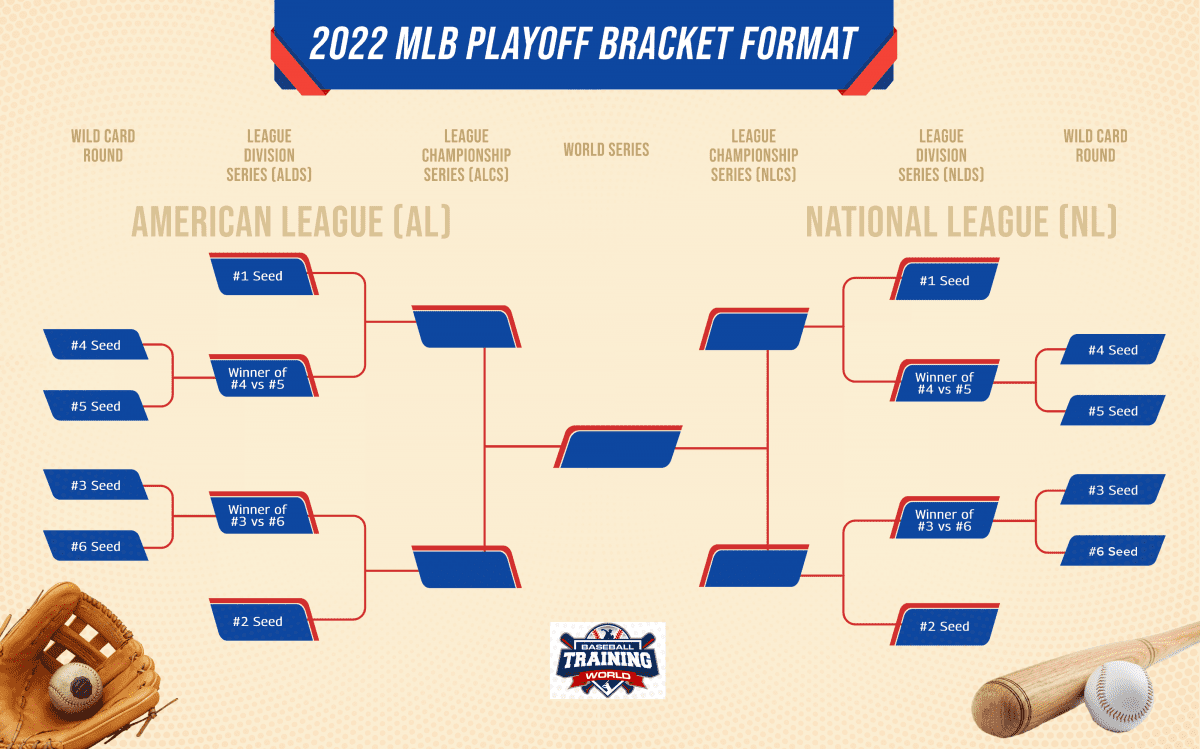
The 2022 postseason added a third Wild Card in each league, creating a field of twelve. Three division champions and three Wild Cards qualified on each side. Unlike the 2020 arrangement, it did not send every participant into the first round: the top two division winners in each league entered at the Division Series.
That change made the term Wild Card round broader than a matchup of two Wild Card qualifiers. The third division winner also played in it. A fan seeing a division champion in an opening series was therefore seeing the correct format, not a team being treated as if it had failed to win its division.
Byes, three-game Wild Card Series and no Game 163
The opening round changed from two single-elimination games across MLB to four best-of-three series. In each league, seed three faced seed six and seed four faced seed five. The higher seed hosted the entire series. Winning one game was no longer enough to advance, but losing the opener was no longer an immediate elimination.
The bracket also specified the next opponents in advance. The 4/5 winner faced seed one, while the 3/6 winner faced seed two. There was no reseeding after an upset. A modern bracket should therefore preserve those paths even when a lower seed wins. Moving a winner across the bracket creates a different tournament from the one MLB scheduled.
The change also removed additional regular-season tiebreaker games, commonly called Game 163. Tied qualification or seed positions were resolved using regular-season results and the applicable tiebreaker order. That is separate from the Wild Card Series: a tiebreaker determines the field or position, while the opening postseason series determines who advances.
For historical comparisons, remember the three different meanings that accumulated around Wild Card. From 1995, it was a qualifying place entering the Division Series. From 2012, it also described a one-game opening playoff. From 2022, the standard opening round became a best-of-three series that includes one division champion on each league side.
If you are filling a current twelve-team sheet, our printable playoff bracket guide gives you a real blank download and completion instructions. Keep an old season's results on a layout appropriate to its own rules; a reusable modern sheet is convenient for today's structure but cannot accurately represent every postseason in this timeline.
How to read an old playoff bracket without using the wrong rules
Start with the season printed on the bracket, then identify the opening round. An eight-team bracket beginning with Division Series may represent the normal 1995–2011 format. A ten-team field with two individual Wild Card games belongs to a different era. A sixteen-team opening round points to the exceptional 2020 tournament, not the twelve-team structure introduced two seasons later.
Next, find the qualification categories. Division winners, first-half winners, second-place clubs and Wild Cards are not interchangeable labels. Using only overall win totals to reconstruct a bracket can miss the reason a team qualified or the reason a stronger overall record did not qualify.
- Confirm the year and whether it had a normal or exceptional format.
- Count the qualified clubs in each league.
- Identify the opening round and any byes.
- Check the number of wins required in every round.
- Read the year's matchup and venue rules before reconstructing its schedule.
When comparing championship runs, compare the routes as well as the total wins. A champion that started in a Wild Card Series played an extra round relative to a bye team. A champion from the pre-LCS era did not need playoff victories to earn its league pennant. Raw postseason wins therefore do not provide a complete, like-for-like description across eras.
Keep proposals out of the enacted timeline. In October 2026, MLB proposed a seven-game Division Series beginning in 2029. That was a proposal, not the 2026 rule. A headline about a possible future arrangement cannot be used to reinterpret a bracket already being played.
For specific past results, use the season's completed archive rather than an article written before its playoffs. A preseason prediction, an early-round update and a final bracket can all contain the same year in their title while answering different questions. Once you have the right year and the right version, this timeline helps explain what each branch, bye and series result actually means.
Loading comments...