

MLB Immaculate Grid is the baseball trivia challenge in which each answer must satisfy two intersecting clues. The game is published by Sports Reference. This independent guide explains how to read its baseball rules, verify a player's record and understand rarity without replacing the game or publishing today's answers.
The safest approach is to identify the pairing first: two teams, a team and a statistical threshold, an award or another category. Then check the exact condition before submitting a name. The difference between a season total and a career total, or between signing with a club and actually appearing for it, often decides whether a plausible guess is valid.
Start with the two clues for a cell
Read a cell as one combined requirement. If its row names one team and its column names another, you need a player who qualifies for both. If one side instead specifies an award, position or statistical threshold, that condition changes the evidence you need. Remembering a famous name connected with one clue is only half of the task.
Use the baseball edition on Sports Reference's Immaculate Grid page, then open its Rules link. The publisher's official help article also explains that selecting a category header reveals its particular rule. This is especially useful when a short label compresses a more precise requirement. Players can be active or inactive, so the answer pool extends beyond today's rosters.
The scoring distinction matters. Under the rules reviewed on November 10, 2026, you have nine initial guesses, and an incorrect choice consumes one just as a correct choice does. After those nine guesses, the game records the score and rarity result. If you missed answers, you may keep guessing afterward, but those later guesses do not change that recorded score. A completed practice board is therefore different from nine correct answers in the scored attempts.
You also cannot reuse the same player within a grid. Before submitting, look across the other cells and consider whether that player might be your only confident answer elsewhere. You do not need to solve everything in displayed order. You do need to preserve a valid choice for each intersection you hope to complete.
The publisher lists a new grid at six in the morning Eastern Time. Check the grid number when comparing results with friends, particularly around a daily reset or when somebody is playing an archive. Decide together whether you are solving entirely from memory or allowing research. That agreement makes a shared challenge more meaningful without inventing a universal standard for how every fan must enjoy the game.
Apply the right rule to each kind of pairing
The same player biography can support one intersection and fail another. Start by classifying the two clues, then ask what would prove that particular combination. A career total, team-season row and award record are different pieces of evidence; knowing one does not automatically establish the others.
Team pairs require real appearances for both clubs
For a team/team cell, the publisher requires at least one regular-season or postseason game for each team. Signing a contract, being traded into an organization or joining its spring-training camp is not the same as appearing for the major-league club. Check both sides independently, including brief stops you remember only from a transaction headline.
A familiar uniform can make a candidate feel convincing, but memory is not evidence of the second appearance. If you are researching, establish the clubs on the player's major-league record. If you are playing from memory, keep an uncertain second connection separate from the first connection you actually know.
Season totals and career totals use different evidence
For a team paired with a season threshold, the qualifying performance must belong to that team in that season. Consider a hypothetical hitter with twenty home runs for one club and fifteen for another. The combined thirty-five does not establish a thirty-homer season for either club. A combined-season total and a team-specific row answer different questions.
A career threshold works differently: the player's overall career achievement can qualify alongside an appearance for the named team. Do not demand that the entire career milestone occurred with that club. For two non-team statistical or award categories, read the category help before assuming both accomplishments must come from the same year. A label that explicitly combines feats into one season still imposes that condition.
Rate statistics deserve another check. The current baseball rules specify no ordinary qualification minimum for the listed batting-average and ERA categories. Applying a batting-title or ERA-title minimum of your own can eliminate a valid answer. Equally, rounding a displayed rate yourself can create a false match; follow the precise category and the record used by the game.
Awards and positions have their own conditions
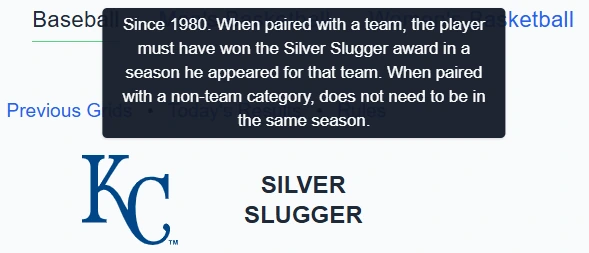
A team/award pairing requires an award-winning season in which the player appeared for that team. The MVP category means regular-season MVP, not League Championship Series or World Series MVP. A position/team pairing requires playing that position for the club, rather than merely being known as that kind of player elsewhere.
Keep franchise history and qualifying appearances straight
A modern logo can represent a franchise with several earlier names and locations. The official help page tells readers to select a team logo to see that history. Use the relationship the game actually supplies, rather than deciding from the city name alone. Brooklyn and Los Angeles belong within the Dodgers' franchise history; that is a different proposition from treating every team that played in one city as the same organization.
Our MLB expansion and relocation timeline provides broader background when an older uniform or team name is unfamiliar. The current teams and divisions guide answers a separate question about today's alignment. Neither should replace the particular franchise history attached to a grid clue, especially when the puzzle reaches beyond the teams and seasons you follow most closely.
After identifying the franchise, prove the appearance. A player's transaction record can contain more organizations than the major-league playing record. MLB's 2024 feature on Jesse Chavez's team memory illustrates how a recalled career path can include non-playing stops. The point for a grid solver is to distinguish the organizational connection from the qualifying game, rather than memorize an old article's team count as a permanent fact.
A short major-league stop can be more relevant than a long association without an appearance. For an unfamiliar candidate, look for the actual games and team abbreviation in the appropriate record. A minor-league affiliate sharing a city, a spring-training invitation or a transaction that was reversed before an appearance does not establish the same thing. Reconstruct the evidence for the specific cell you selected.
Names create another avoidable trap. Two players can share a surname or have very similar names, while a familiar nickname can lead you to the wrong entry in a selection list. Compare the full name and career era before submitting. If you remember a player through a relative, coach or broadcaster, confirm that the person you selected is the player whose record satisfies both clues.
Check a player without wasting a scored guess
When research is part of your chosen way to play, make it targeted. First write the exact requirement you are trying to prove. Then inspect the relevant record, rather than gathering an assortment of interesting facts about the player. A correct fact can still answer the wrong question.
Read the relevant statistical row
For a team intersection, the Baseball-Reference multiple-franchise finder is a useful starting point linked by the publisher's own information hub. Its description treats relocated versions of the same franchise together. A candidate list helps you discover possibilities; the particular grid condition still determines what else you must verify.
For a season threshold, match the year, club and statistic before looking at the number. A combined-season line can sit beside separate team rows, and selecting the combined value is exactly how a two-team performance can become a mistaken team answer. For a career threshold, move to the relevant career total instead of demanding one qualifying season. For an award, check the award year and club relationship; a current team name at the top of a profile does not establish the historical connection.
Pause over labels that look similar. Home runs, hits and runs batted in are different totals. A pitching appearance does not establish a win, and an appearance at one defensive position does not establish another. Read the column heading out loud if necessary. That small habit is more effective than submitting a guess and hoping the game meant the statistic you remembered.
Save flexible players for the cells that need them
A player who fits several intersections can be valuable precisely because the no-reuse rule limits where you can spend that answer. Suppose you know two candidates for one cell but only one candidate for another, and the shared player fits both. Use the alternative in the first cell and preserve the shared answer for the second. This is a planning problem, rather than an invitation to make every choice obscure.
Our historical great-player guide can prompt useful career memories, but fame alone proves no particular match. The same is true of online journeyman lists: they are starting points, not permanent guarantees. Before submitting, check the full player identity, both clues, the category's time scope and whether the name has already been used. If you are playing without outside research, apply the same checklist to the facts you can confidently recall.
Understand rarity without confusing it with correctness
The game records two different ideas: how many scored guesses were correct and how obscure the chosen answers were. Start with validity. An answer either satisfies the relevant conditions or it does not. Choosing a familiar superstar does not make a valid answer less correct, and selecting an obscure player does not repair a missing team appearance or an incorrect season total.
Rarity supplies another challenge after you understand that foundation. A less commonly chosen valid answer can make a result feel more distinctive. It does not imply that the player was worse, that a famous player was the wrong choice or that the solver knows more about every part of baseball. Recognition depends heavily on which teams and eras a fan followed.
Former major leaguer Doug Glanville's reflection on rarity offers a useful human perspective: a name that is obscure to one audience can carry a vivid memory for another. You may immediately recall a backup catcher from your favorite club while overlooking a widely celebrated player from another generation. The puzzle turns those uneven memories into interesting discoveries rather than a complete ranking of baseball knowledge.
Before chasing a less obvious candidate, establish at least one choice you trust. Then compare the alternatives against both clues. If the unfamiliar option rests on a half-remembered transaction or an uncertain statistic, decide whether you value the risk of a miss more than a confident completion. A nickname on a social-media list is not stronger evidence simply because fewer people might think of it.
Compare results in the right context. Use the same grid number, distinguish the first nine scored guesses from later practice and agree on whether research was allowed in your shared challenge. Avoid declaring one universal rarity target the measure of success for every puzzle. A satisfying result can be a fully correct grid, a carefully verified unfamiliar answer or a mistake that teaches you something worth remembering. Keep those goals separate enough to enjoy each of them.
Build a better baseball memory after the grid
After your scored attempts, choose one uncertain connection to investigate properly. Record the player, both clues and the evidence that makes the match valid. A short explanation is more reusable than a screenshot of nine names because it preserves the reasoning you will need when similar categories appear in another combination.
Organize those notes around connections you can recall: an unusual trade, a brief major-league stop, a position change or a surprising statistical season. Add the relevant year and distinguish a confirmed appearance from an organizational association. Resist turning a memory notebook into a collection of unsupported answers copied from social posts.
Some clues require more precise research than their names suggest. The official World Series Champ rule, when paired with a team, requires a postseason appearance or a place on the World Series roster during that club's championship season. Regular-season membership alone is insufficient. Our historical champions list can help identify a winning club and year, but it cannot establish that individual eligibility.
Review the reason for a miss
Classify the mistake before trying to remember more names. Different errors call for different repairs:
| What went wrong | What to check next |
|---|---|
| Right surname, wrong player | Full name and career era in the selection list |
| Correct player, wrong team connection | Franchise history and an actual qualifying appearance |
| Correct achievement, wrong time scope | Team-season row versus combined season or career total |
| Correct championship team, ineligible player | The category's postseason appearance or roster requirement |
| A WAR total misses the threshold | The specific provider and qualifications named in the category |
For WAR, the publisher's category explanation specifies Baseball-Reference WAR. Do not substitute another site's version because the acronym looks the same. The rule also explains how pitching, position-player and combined values are treated, so inspect it before discarding a candidate whose overall number differs from one component.
Use the available unscored continuation to test what you learned, while keeping the original result distinct. One corrected relationship is enough to improve the next session: an actual team appearance, a correctly read statistical row or a category exception you now understand. Let that discovery lead you back into baseball history rather than making an unfamiliar name valuable only for its potential rarity.
Loading comments...