
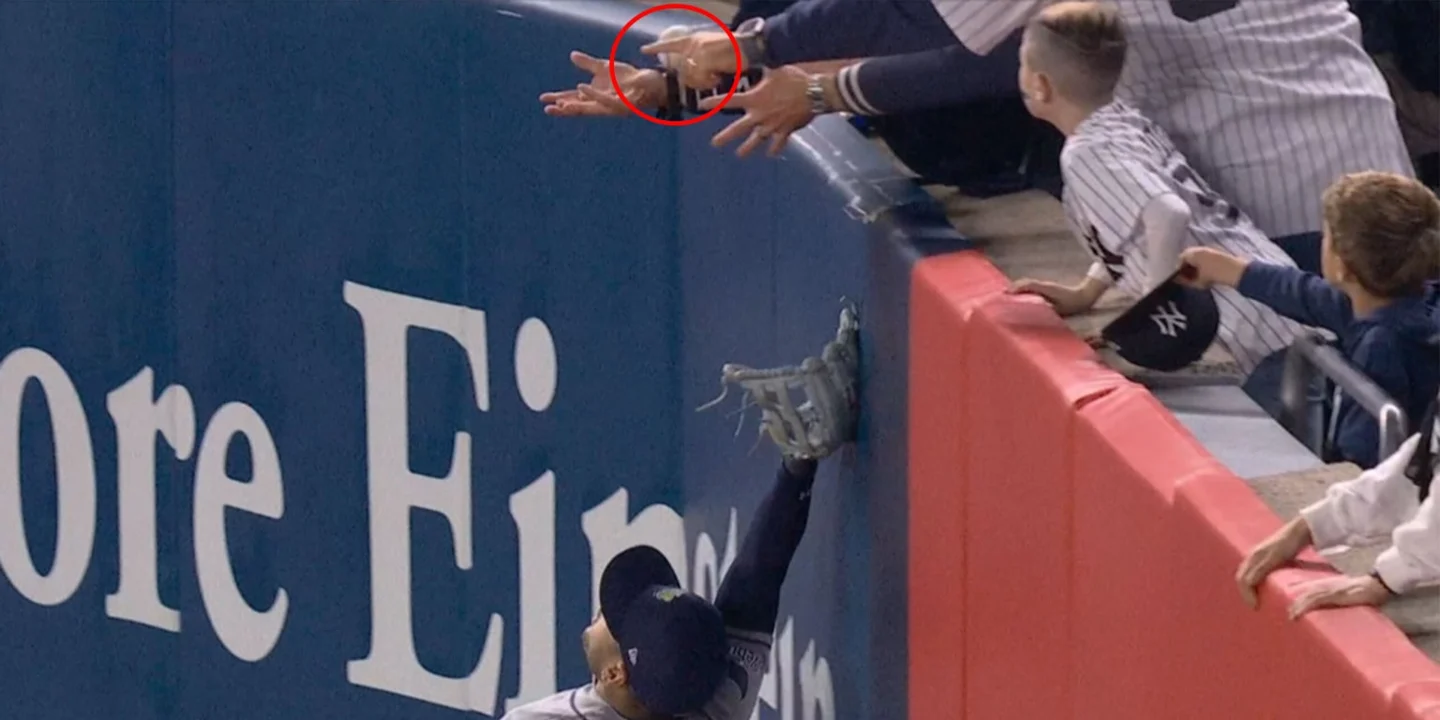
MLB fan interference occurs when a spectator intrudes into the playing field and affects a live ball or a player. The result depends on what the interference prevented. It can mean an out, an award of bases or the removal of an apparent home run. It does not carry one automatic two-base penalty for every situation.
Why Volpe's apparent home run became a double
Anthony Volpe's apparent tying homer became an RBI double after spectator interference in ALDS Game 3 on October 7, 2026. MLB's official review video shows the change in the ruling. The news report was published the following day, which is why October 8 also appears in accounts of the incident.
The explanation involved three different questions. Had the spectator reached into the field? Would the ball otherwise have cleared the fence? Would the outfielder otherwise have caught it? Those questions are related, but an answer to one does not automatically answer the others. A fan can touch a ball inside the boundary without preventing a catch that a fielder was actually going to make.
In this case, the official review determined that the ball would have remained in play and would not have been caught. Volpe was placed at second and the preceding runner was awarded home. The award therefore did not treat the ball as a home run, and it did not treat the interference as a prevented catch requiring the batter to be out.
That distinction is the key to understanding similar plays. The word interference identifies the problem; the remainder of the ruling explains how the crew repairs its effect on the game. A television announcement that a home run has been overturned may tell viewers only the first part of that explanation. Listen for the runner placements before trying to reconstruct the score and the next batter's situation.
The interference also should not be used as a shortcut for explaining an entire team's postseason outcome. The play changed one sequence within a game. Assigning a series result to one spectator goes beyond identifying the rule and obscures the decisions the umpires actually had to make. The practical question is what the play would reasonably have produced without the intrusion, not which fan deserves blame for every later result.
Where the ball and the fan meet determines the boundary
The important boundary is between the playing field and the spectator area. Under Rule 6.01(e), a spectator can interfere by entering the field or reaching over, under or through a barrier and affecting a live ball or player. The interference can involve a batted ball or a thrown ball. It is not limited to a near-home-run catch.
Foul territory can still be part of the playing field. A ball heading toward seats down a baseline has not necessarily become an unplayable souvenir merely because it is foul. If an intruding spectator prevents a fielder from catching a foul fly in playable territory, the prevented-catch rule can matter just as it does on a fair fly.
Reaching into the field is different from a fielder reaching into the stands
The official rule distinguishes a spectator reaching toward the field from a fielder reaching into the stands. A fielder pursuing a ball beyond the barrier takes that risk. Ordinary competition for a ball on the spectator side is not automatically interference simply because the fielder might otherwise have made a spectacular catch.
For a possible home run, that makes the point of contact crucial. If the ball has crossed into the spectator area and a fan catches it there, the fan's success does not itself turn the home run into an out. If the fan reaches onto the playing-field side and takes the ball away from a fielder, the crew faces a different rules question. The same seat and the same spectator can produce different rulings depending on where the interaction occurs.
A useful replay should show the barrier, the ball and the hands or glove at contact. A shot focused only on the spectator celebrating may leave out the evidence that matters. The fan's feet remaining in a seat does not establish that the hands stayed out of the field. Similarly, the fact that a fielder's glove extended over a wall does not establish that the ball was still within protected playing space.
A fan can interfere with a player as well as the ball
Ball contact is not the only relevant action. Reaching into the field and touching or obstructing the player can affect a catch even if the spectator never gets a hand on the baseball. Pulling at a glove, blocking an arm or otherwise disrupting a player can therefore require a ruling.
The rule about a fielder taking a risk in the stands should never be read as advice to grab the player. The baseball consequence and spectator-conduct consequences are separate, and forceful contact introduces an obvious physical danger. A spectator trying to understand a replay should ask where and how the player was affected; a spectator sitting at the wall should give the player room to complete the attempt.
Why fan interference is not automatically an out or two bases
The governing principle is to remove the effect of the interference. Rule 6.01(e) makes the ball dead at the interference and gives the umpires authority to impose the result that reasonably restores the play. Its specific prevented-catch provision requires an out when the spectator clearly stopped a fielder from catching a fly ball.
That is why the out question cannot be answered merely by proving a spectator touched the ball. Suppose a fan reaches into the field and picks up a rolling fair ball with no possible catch involved. The interference still needs a remedy, but the prevented-fly-catch provision does not supply an automatic out. The crew must determine the appropriate bases for the batter and any runners.
Awarding second to the batter does not establish that every spectator-interference play is a ground-rule double. A ball bouncing out of play and a spectator interfering with a ball that remains in play are different events. The result may look identical in the box score while arising from a different rule and a different assessment of the runners.
How umpires decide where runners belong
The crew considers where the batter and runners would have been without the interference. That is a judgment about the interrupted play, not simply an instruction to advance everyone the same number of bases. Where the ball was, whether it could be fielded promptly and how far runners had progressed all help explain why the placements can differ.
The rulebook's own example shows why an out and a run can coexist. With a runner on third and fewer than two outs, a spectator clearly prevents a catch of a deep fly. The batter can be declared out while the runner is allowed to score if the umpire judges that the runner would have scored after the catch. A much shorter fly may produce a different assessment.
The dead-ball ruling is another important limit. Runners continuing around the bases after the interruption do not get to establish their own award by running farther. The umpires' placement controls. A spectator at home should wait for that complete decision rather than assume every runner who crossed the plate has scored.
Postseason context does not replace these principles with a special interference penalty. Similarly, the postseason extra-innings runner rules govern a different question: who begins an extra inning on base. Neither the inning nor the game's importance converts spectator interference into a uniform two-base award.
What replay can review on a boundary play
Potential spectator interference at a stadium boundary is reviewable. MLB's replay-review explanation includes both home-run and non-home-run boundary calls, along with runner placements following a boundary decision. That permits a review to address more than whether the scoreboard should add a home run.
In a near-home-run play, the review may need to establish where the ball was touched, whether it would have left the field and whether the contact prevented a catch. Once the underlying play is resolved, the batter and runners still need correct placements. The final announcement can therefore remove an apparent homer while retaining a run and placing the batter on base.
Replay also depends on the available evidence. A call can be confirmed, overturned or allowed to stand when there is insufficient clear evidence to change it. A crowd's reaction or a commentator's strong opinion does not substitute for a useful view of the contact. Even a dramatic close-up can be unhelpful if it loses the fence line or the ball at the crucial moment.
For viewers, a short replay checklist helps: locate the barrier, identify the precise contact, assess whether a catch was prevented, then listen for every runner's award. Jumping from the first image to a proposed punishment for the spectator skips the decisions that determine the game state.
Other rules also use the word interference. A bat contacting a catcher's mitt, a runner hindering a fielder and a spectator reaching over a wall are different situations. Their penalties and review procedures should not be mixed together. The guide to replay and catcher interference covers those separate pitch-related questions. Calling a play interference does not by itself tell you which rule applies.
Stadium penalties are separate from the baseball ruling
An umpire resolves the effect on the game. A club or MLB can separately decide how to respond to the spectator's conduct. An out or a base award does not itself specify a universal ejection, ticket cancellation or ban. Those consequences should be checked from the relevant club or league statement rather than assumed from the interference signal.
The 2024 World Series incident involving Mookie Betts illustrates the distinction. Two spectators forcefully grabbed at the Dodgers outfielder during a foul-ball play. The baseball ruling was an out. MLB later reported an indefinite ban from its facilities, following the initial removal and next-game ticket action. That documented response addressed the spectators' conduct and player safety; it was not a new automatic penalty added to every interference play.
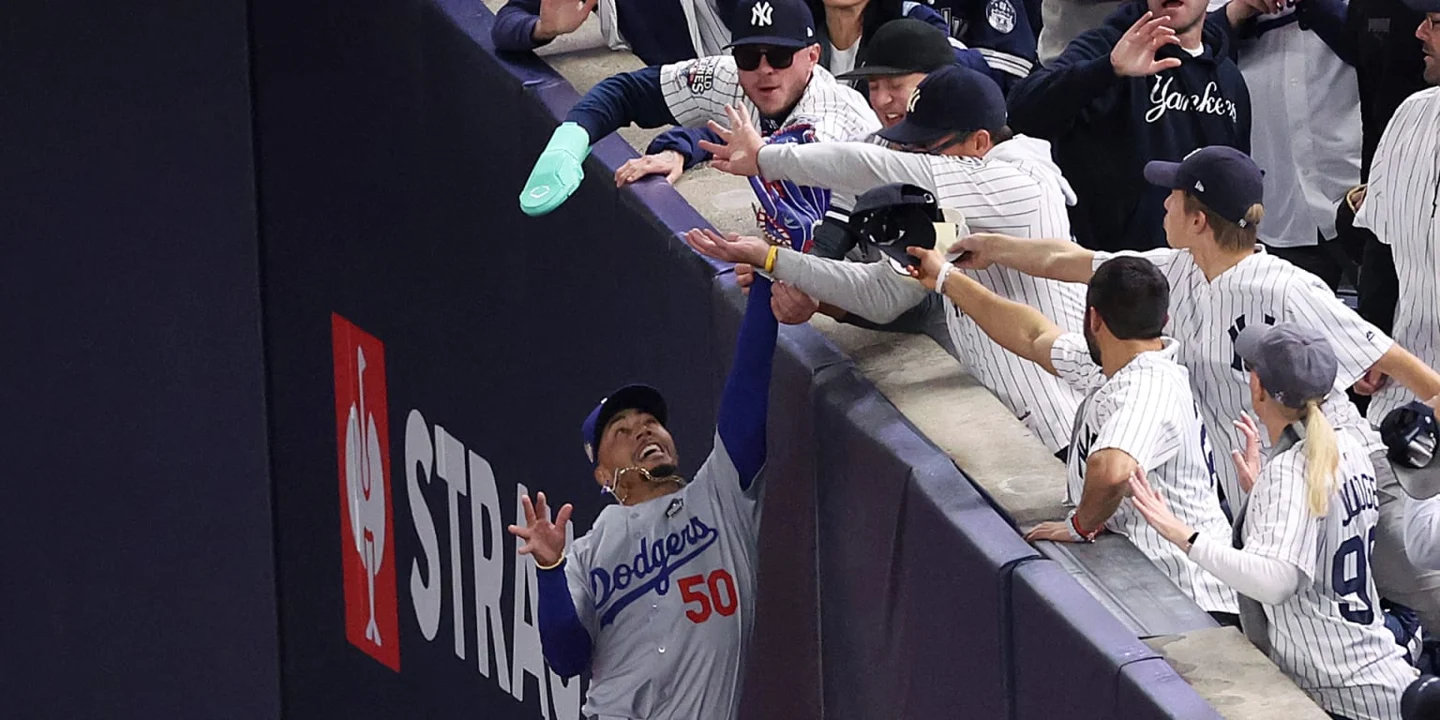
It is therefore possible to understand the baseball ruling without knowing the spectator's identity or later disciplinary status. Those details are not required to decide where runners belong. Conversely, a conduct response can matter even when the box-score consequence appears minor. The score does not measure the physical risk created by pulling a player's arm or glove.
What spectators near the wall should do
Keep hands and equipment on the spectator side while a ball is live. Let a ball reach the seats before treating it as a souvenir, and give fielders room when they pursue a catch. Avoid leaning through openings, moving barriers or grabbing a player. Being seated in the front row gives a good view; it does not make the field an extension of the seating area.
If a ball rolls near an opening, leave it alone until the play is over. Do not try to help the home team by stopping a ball or help a player by handing it back during a live sequence. Good intentions do not prevent the act from changing the play. If a safety or seating issue develops, involve stadium staff.
For fans planning a postseason visit, the MLB playoff-format guide explains how the series fits into the tournament. Once inside the ballpark, the practical responsibility remains simple: watch the action and preserve the players' opportunity to complete it. A spectator can enjoy a close view without becoming part of the ruling.
Four situations that are easy to misread on television
The following examples are hypothetical. They show how the same general rule can produce different outcomes without requiring a different rule for each team or stadium.
A fan takes a fly ball away inside the boundary. An outfielder is positioned to catch it, but a spectator reaches into the field and clearly prevents the catch. The prevented-catch provision can make the batter out. Watch the contact and the fielder's opportunity, rather than assuming that every ball near the wall would have been a home run.
A fan picks up a rolling ball. No fly-ball catch is possible. The umpire still calls interference and makes the ball dead, then places the batter and runners to remove its effect. Do not automatically award every runner two bases or declare the batter out. The locations and likely continuation of the play matter.
An outfielder reaches beyond the fence. A ball is on the spectator side when a fan catches it during the fielder's attempt. The player's effort alone does not create spectator interference. Establish where the contact occurred before comparing it with a case in which a fan reached into the field. Avoid treating a difficult attempted robbery as proof that a catch was protected everywhere.
A prevented deep catch also produces a run. With a runner on third and fewer than two outs, the batter can be out for interference while the runner is awarded home based on what would have followed the catch. That is not inherently contradictory. Check the out count and the crew's runner placement before concluding that an out requires everyone to return.
For any actual game, the useful sequence is boundary, contact, prevented catch and runner placement. A replay without all four elements may leave a legitimate question unanswered. The current MLB game list and TV schedule can help you find the next broadcast; when another boundary play occurs, wait for the full ruling before deciding what changed on the scoreboard.
Loading comments...