
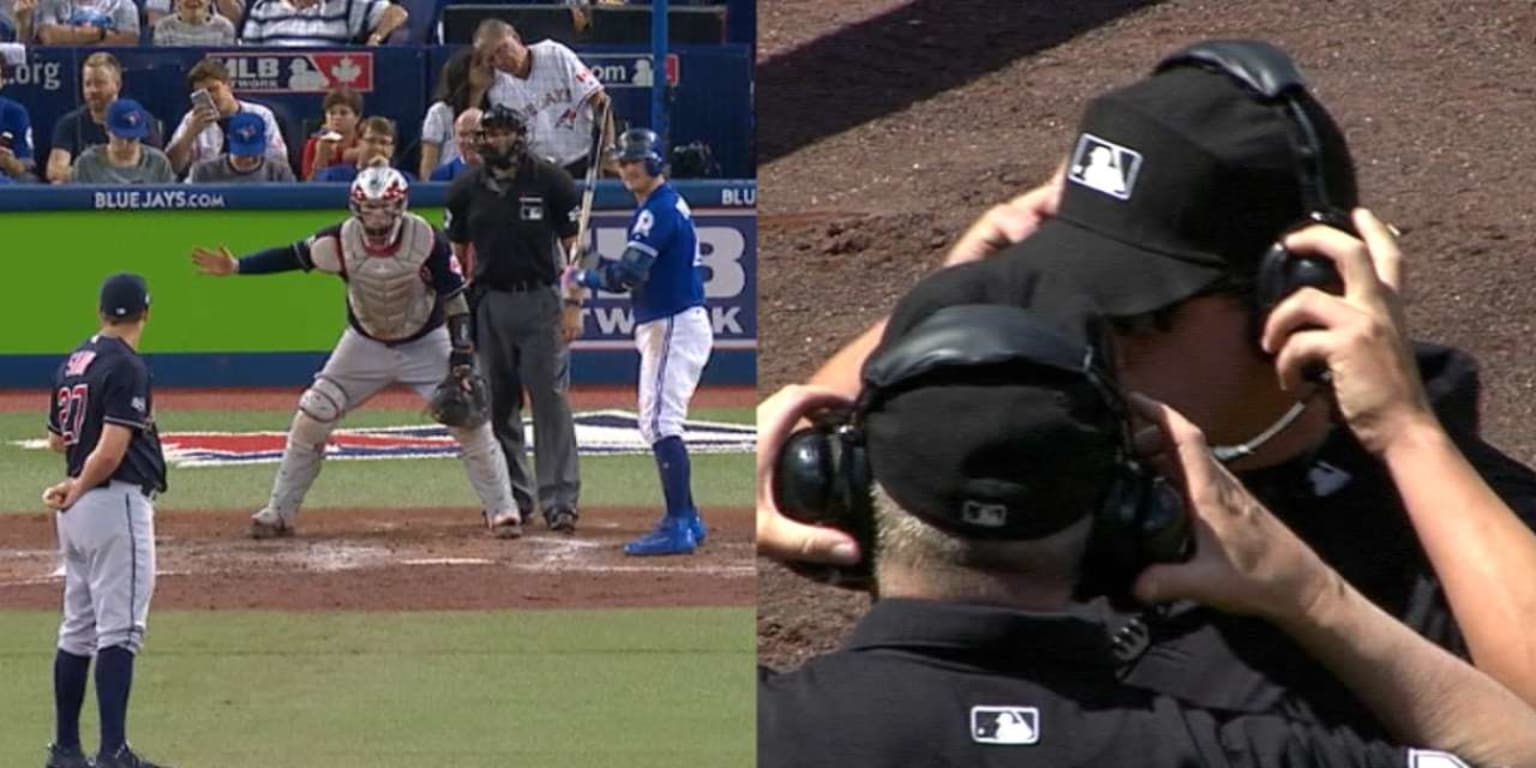
What can MLB replay review change?
MLB replay review can change designated calls such as a close tag, whether a pitch touched a batter, or a disputed catcher's interference ruling. It is not a chance to re-officiate every part of a play. The useful question while watching is specific: what decision are the officials reviewing?
A manager can challenge a reviewable call, and the umpire crew chief can initiate certain reviews. Replay officials in New York examine the available angles and return a decision to the on-field crew. The broadcasters' slow-motion analysis can help you follow the action, but their conclusion is not the official ruling.
At the plate, several events can happen almost together: a pitch arrives, a batter moves his bat, the catcher reaches forward, and the ball changes direction. A review of whether the ball touched the batter answers a different question from whether the bat contacted the catcher's mitt. Identifying one event does not automatically establish the other.
That distinction is particularly useful in the 2026 postseason, which has both traditional replay and the newer Automated Ball-Strike challenge system. A replay headset conference, a player's request to check a called pitch, and an appeal to a base umpire on a swing are not interchangeable procedures.
When a review changes a ruling, the consequences can include more than changing a word on the score graphic. Officials may need to resolve the batter's status or where runners belong after the corrected play. Wait for the announced result and the resumption of play before deciding that a runner should be at a particular base.
This guide explains the contact calls and challenge limits fans are most likely to confuse. The rules and dated examples were checked as of October 10, 2026. The aim is to help you understand the next ruling on screen, without turning a close camera angle into an unsupported claim about what the officials intended.
Can a hit-by-pitch call be overturned?
Yes. Replay can determine whether a pitch contacted the batter, his clothing, or his bat. That can turn an apparent hit-by-pitch into a different ruling, or establish contact that was missed on the field. A ball brushing a sleeve is different from a ball striking the bat, even if both produce a small change in its direction.
For a current example, MLB's October 7, 2026 official ALDS clip records Tristan Peters continuing his fourth-inning plate appearance in the Guardians at White Sox game after a hit-by-pitch ruling was overturned. The same review result included no catcher's interference. That is a useful reminder that an apparent route to first base can disappear once the relevant contact is checked.
The official result is enough to explain that outcome. It does not, by itself, establish a league-wide controversy or tell us why every spectator disagreed with a particular angle. Nor should it be combined with a different team's viral clip just because both search results mention interference.
While watching a similar review, focus on the ball's route immediately before and after the possible contact. A wide camera angle can make the ball appear to overlap a sleeve without clearly showing a touch. A closer angle may resolve that uncertainty, but the final decision comes from the replay process rather than the number of times the television broadcast repeats a frame.
Contact is reviewable; avoiding the pitch is a separate question
The physical-contact question is only one part of the hit-by-pitch rule. MLB's replay glossary distinguishes it from whether the pitch was in the strike zone when it touched the batter and whether the batter tried to avoid it. Those judgments are outside the specified hit-by-pitch replay review.
Consequently, showing that a ball touched a batter does not mean a manager can use the same review to reopen every decision about the pitch. The underlying rule also distinguishes a pitch the batter swung at from an ordinary hit-by-pitch award. Keep the award rule separate from the permitted scope of video review.
Imagine a pitch that seems to catch a loose jersey sleeve near the bat. Reviewing whether it touched the sleeve or the bat is a contact question. Arguing that the batter leaned toward the pitch is a different question. Fans can discuss both, but a replay challenge is not necessarily allowed to decide both.
Once the call is announced, check what actually happens next: does the batter go to first, return to the box, or face a different count? That makes the effect of the ruling clearer than relying on a commentator's initial description before the officials have finished.
Can catcher's interference be reviewed?
Yes. Current MLB examples show replay determining catcher's interference, including a call that was not originally made on the field. Be careful with old search results that list interference as universally unreviewable. A historical discussion may predate the procedure you are seeing in a 2026 game.
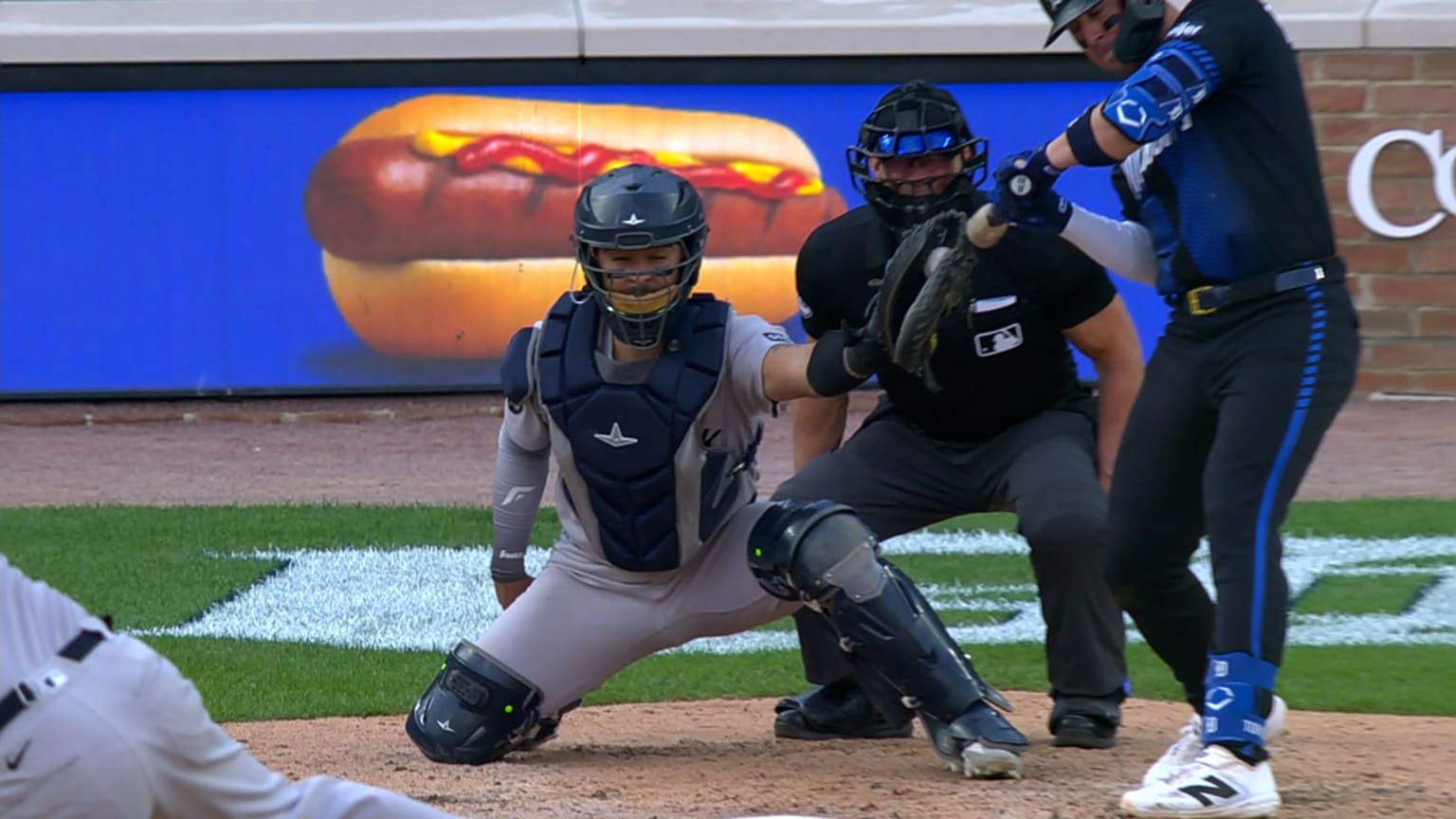
In MLB's June 22, 2026 Yankees at Tigers clip, Spencer Torkelson received first base following a fifth-inning interference review. Compare that result with the October 7 ALDS example above, where the announced result included no interference and Peters' at-bat continued. A review can establish contact or leave a no-interference ruling intact; it does not guarantee an award to the batter.
Bat-and-mitt contact is different from a checked swing
The familiar interference situation involves a batter's bat contacting the catcher's mitt during the pitch. That is a different question from whether the batter offered at the pitch. A swing appeal asks about the batter's action; an interference review examines the obstruction or contact being challenged.
For that reason, the appearance of a checked swing does not automatically rule out catcher's interference. Conversely, reviewing possible interference does not mean replay officials have been given authority to reverse the checked-swing judgment itself. A single movement can create two questions with different procedures.
When watching the replay, look at the space between the bat and mitt rather than assuming a ruling from how far the bat traveled. The review is not a public vote on whether the swing looked convincing. Nor is there a simple television rule that every bat crossing the front of the plate settles every type of call.
Keep other interference situations separate as well. A runner colliding with a fielder, a fan reaching over a fence, and a catcher impeding a batter are different rule categories. The fact that this catcher-contact question is reviewable does not establish that every incident described as interference can be challenged in the same way.
First base is a common result, but the play can still matter
The normal catcher-interference penalty gives the batter first base and advances runners who are forced by that award. A runner at second with first base empty is not automatically forced to third merely because the batter receives first. Check the base situation rather than moving every runner forward in your mental scorecard.
Interference also does not always erase a useful result from a ball put in play. MLB's rule permits the play to develop because the offense may prefer the result to the penalty. The offensive manager can elect that result when the rule provides the option.
As a simple hypothetical, a run-scoring groundout can leave a manager choosing between the play's result and the interference penalty. That is a separate choice from challenging whether contact happened. First the ruling establishes what occurred; then the applicable rule determines the award or available option.
Listen for the final explanation and watch the bases after the conference. A batter going to first is only part of the outcome. Runner placement, outs, and any accepted play result are what determine how the inning resumes.
How many replay challenges do MLB managers get?
Managers begin a regular-season game with one traditional replay challenge and a postseason game with two. MLB's September 1, 2026 postseason explanation confirms that difference. These are starting allowances for the game, not a stock of challenges carried from one playoff round to the next.
A successful challenge that overturns a call is retained. An unsuccessful one is used up. For a simple playoff example, a manager who wins his first challenge still has the two he started with; a manager whose first challenge fails has one left. The starting number should not be mistaken for an absolute limit on how many successful reviews a team can have.
Running out of challenges also does not mean that every remaining review is impossible. The crew chief can initiate a potential home-run review at any time. From the eighth inning onward, the crew chief can initiate reviews of other reviewable calls, including after a request from a manager with none remaining. That is discretionary umpire action, not an automatic extra challenge granted to the manager.
The manager's decision window and the officials' review time are different clocks. MLB introduced a 15-second challenge-decision timer in 2023 after the manager signals that a challenge is being considered. That does not mean the replay officials must complete the entire review in fifteen seconds, or that a long television delay automatically changes the call.
For the round and matchup in progress, our 2026 playoff schedule and bracket guide provides the postseason context. The challenge allowance resets for each game; it is not increased simply because a series reaches an elimination game.
Confirmed and stands leave the call unchanged for different reasons
An overturned call changes the on-field ruling. A confirmed call remains in place because the review supports it. A call that stands also remains in place, but the evidence did not meet the standard needed to reverse it. The last two outcomes look alike on the scoreboard while saying different things about what the available angles established.
This matters when a fan says, “They never proved the umpire was right.” Replay does not require every review to prove the original decision beyond all doubt. If the available evidence cannot justify a reversal, the original call can remain. Stands is not an official admission that the call was wrong.
For challenge accounting, both unchanged outcomes mean the manager did not obtain an overturn. Watch the broadcast's remaining-challenges graphic after the decision rather than assuming that an inconclusive angle preserves the challenge. Understanding the announced outcome helps explain both the current play and the manager's options later in the game.
Replay review and ABS challenges use different systems
Traditional replay and the Automated Ball-Strike challenge system can both change a ruling, but they check different questions and use separate challenge allowances. Losing a manager's replay challenge does not, by itself, spend the team's ABS challenge. The fact that a playoff team starts with two of each does not make them a single pool of four interchangeable requests.
| Question on the field | Relevant process | What to watch for |
|---|---|---|
| Did a pitch touch the batter or bat? | Traditional replay of reviewable contact | Manager challenge or appropriate umpire review |
| Was there catcher's interference? | Traditional replay of the interference ruling | Bat-and-mitt contact and the announced award or result |
| Was a called pitch a ball or strike? | ABS challenge | Immediate request by the batter, pitcher, or catcher |
| Did the batter swing in an MLB game? | On-field swing decision and applicable umpire appeal | Do not treat a minor-league swing experiment as MLB replay authority |
ABS reviews called balls and strikes
In the 2026 MLB challenge system, the home-plate umpire still makes the initial ball or strike call. The batter, pitcher, or catcher can request an ABS check immediately, using the prescribed cap or helmet signal. It is not the manager's usual replay request after consulting the dugout about a close tag.
Teams begin with two ABS challenges and keep successful ones. If a team begins an extra inning with none left, it receives an additional ABS challenge. MLB's current postseason explanation says the ABS system operates under the same rules in October as in the regular season.
The important limit is what ABS measures. Pitch location can resolve a disputed called ball or strike; it does not decide whether a batter offered at the pitch or whether his bat contacted the catcher. A pitch outside the zone is not an automatic escape from a strike caused by a swing. Those are different elements of the ruling.
Similarly, do not assume that every contact review can be turned into an ABS request after the officials have finished. The procedures have their own timing and sequencing requirements. Fans who want the full player-request and strike-zone explanation can use our MLB ABS challenge system guide.
Checked-swing experiments do not make MLB swings reviewable
MLB has tested technology for checked-swing decisions in development leagues. Its 2026 Minor League rules report describes the Check Swing Challenge starting in the Triple-A Pacific Coast League on May 5. That is evidence of an experiment at that level, rather than approval for the 2026 Major League postseason.
An Arizona Fall League article or a Triple-A highlight can therefore show a genuine swing challenge while describing a procedure unavailable in the MLB game you are watching. Always identify the competition and date before applying a clip's rules to a Major League matchup.
The experiment also uses its own defined swing threshold. Do not import that experimental cutoff into an MLB argument as though a bat's measured angle automatically requires a particular Major League decision. A camera replay shown by the broadcaster is not itself an authorized swing review.
If an MLB plate umpire asks a base umpire for help on a checked swing, that is an on-field appeal. It should not be counted as the manager spending a traditional replay challenge or the batter using ABS to measure his swing. Keeping those three procedures separate makes the next close pitch much easier to follow.
How to follow a replay decision without guessing
Start by identifying the game, inning, and player. Two clips with similar titles can involve different teams or seasons. Then find the original call and the question being reviewed. Was the dispute about pitch contact, interference, a tag, or a called ball or strike?
Next, identify the process. A manager's replay challenge, a crew-chief review, an ABS request, and a checked-swing appeal have different limits. The generic word challenge in a headline does not tell you which allowance was used.
Finally, listen for the outcome and check the corrected situation on the field. Confirmed, stands, and overturned explain what happened to the original ruling. The batter's location, runner placement, count, and number of outs explain how the inning continues.
When revisiting a completed play, MLB's official replay database can help identify the date, challenging team, review category, and outcome. An official clip or game record gives firmer context than a cropped social-media video that ends before the ruling is announced.
Our MLB Gameday and play-by-play guide explains how to follow the game log, and MLB games today helps locate the current matchup. Use those alongside the broadcast to follow the corrected play. This article explains the rules; the live game determines which calls have been challenged and how many opportunities each team still has.
Loading comments...