
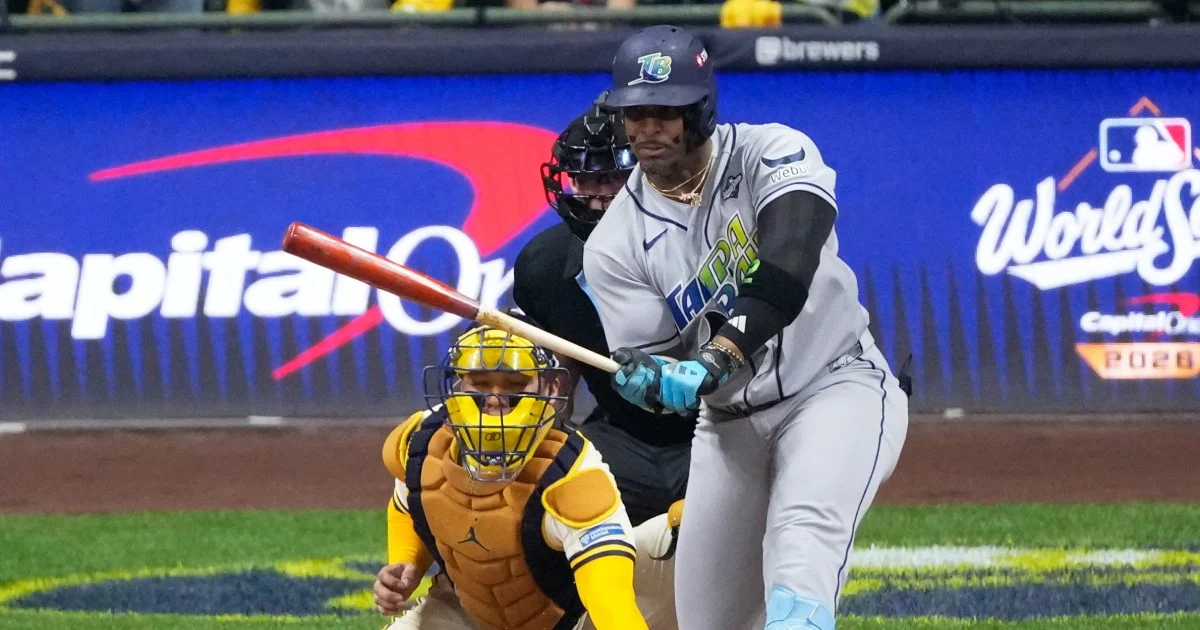
A checked swing in MLB is an umpire's judgment about whether the batter attempted to hit the pitch. The published rules do not turn that judgment into a universal test based on the wrists, the front of the plate or a particular bat angle. If the plate umpire calls a ball, the defense can request help on the swing. A swinging strike does not give the batter an equivalent right to demand the reverse appeal.
What the World Series ending does and does not prove
The final pitch of World Series Game 2 on October 24, 2026, brought those distinctions into focus. Milwaukee beat Tampa Bay 5-4 after Aaron Ashby struck out Yandy Díaz on a checked swing. MLB's official game-ending clip records the result. The debate concerned whether Díaz had swung, rather than a disputed catch, tag or ball landing near a boundary.
With two outs, a full count and a runner at third, the difference was substantial. An unchanged ball call would have extended the inning with a walk. Instead, after Milwaukee catcher William Contreras requested assistance, the base umpire judged that Díaz had offered at the pitch. The resulting third strike ended the game. That procedural change from ball to strike is permitted by the check-swing appeal rule; it does not depend on the opposing manager using a replay challenge.
A viewer can disagree with that judgment while still recognizing that the crew followed a procedure the rules provide. Two separate questions deserve separate answers: was the swing judged correctly, and was the defense entitled to ask another umpire? The first involves evaluation of the movement. The second can be answered from the rulebook. Treating both questions as a single controversy makes it harder to understand what actually happened.
The ending also did not establish a new standard for later games. A televised graphic, a former player's preferred test or a social-media reconstruction can help explain a person's opinion. None becomes an adopted MLB rule simply because it is persuasive or widely shared. Likewise, a proposed technological solution does not mean the umpires had that solution available during this game.
This guide describes the MLB procedure as checked on October 27, 2026. It uses the World Series play as a dated example rather than a verdict from a still image. The useful lesson for the next game is to identify which decision is being disputed before asking whether it can be challenged. A ball's location, the batter's offer and a separate play involving a runner may happen within seconds, but they follow different review paths.
What counts as a swing under MLB rules
The starting point is the definition of a strike in the Official Baseball Rules linked by MLB. One route is a legal pitch the batter offers at and misses. Another is an unoffered pitch that passes through the strike zone. The book describes a half-swing appeal procedure, but it does not publish a separate, exact geometric definition that settles every stopped swing.
That leaves an umpire to judge whether the batter's movement constituted an offer at the pitch. It is a judgment standard, rather than permission to ignore the rules. The difficult boundary is between beginning a swing and stopping short of an actual attempt. A slow-motion replay lets viewers inspect that boundary repeatedly; the on-field call is made at game speed.
Why wrists, the plate and camera angles are imperfect shortcuts
You will hear that the batter must break the wrists, pass the front of the plate or move the barrel beyond a certain line. Those expressions are familiar ways to describe what a swing looks like. They are not interchangeable clauses in the current MLB rulebook. Showing one of them on a screenshot does not by itself establish a rules violation.
For example, a hitter can move the hands well forward while trying to hold the barrel back. Another hitter can rotate the barrel with a different hand path. The movement still needs to be judged as an offer, rather than reduced to whichever body part a television camera happens to show most clearly. An overhead angle may reveal information missing from the center-field view, but it does not introduce a different governing rule.
Camera perspective also matters when comparing the bat with a line drawn on a broadcast. A two-dimensional image may not faithfully show the bat's position relative to a three-dimensional reference. That is a reason to be careful with a definitive claim, not a reason to dismiss every useful replay. Multiple angles can inform an opinion without converting that opinion into an official review result.
A swing and a pitch in the strike zone are separate questions
A batter who successfully checks has avoided a swinging strike. The batter has not automatically earned a ball. If the pitch travels through the applicable strike zone, it can still be a called strike. Conversely, a pitch far below the zone can become a strike when the batter offers and misses. The location graphic alone cannot resolve that second situation.
Consider two hypothetical pitches with two strikes. On the first, the hitter holds up on a breaking ball below the zone and the umpire judges no offer: the pitch can be a ball. On the second, the hitter holds up equally well but the pitch is in the zone: the result can be strike three. Now change the first example so that the umpire judges an offer. It becomes a swinging strike even though the ball stayed low.
That distinction explains much of the confusion around a check-swing appeal. The base umpire is providing help on the offer, not remeasuring where the pitch crossed home plate. A television box showing a pitch outside the zone therefore does not contradict a swinging-strike ruling. First establish why the strike was called; then evaluate the relevant decision.
Who can request a check-swing appeal
Rule 8.02(c)'s comment gives the manager or catcher a specific route: when the plate umpire calls the pitch a ball, they may request that the plate umpire ask a partner about the half swing. On such a request, the plate umpire must refer the swing judgment to a base umpire. If that umpire judges a swing, the strike takes precedence over the original ball call.
The request goes through the plate umpire. A catcher pointing down a baseline is asking for assistance through that process; the catcher is not personally overruling the call. Nor does the defending club acquire a right to pick whichever umpire it thinks will give the most favorable answer. The crew handles the consultation.
The asymmetry is explicit. The procedure applies when the original call is a ball, not when it is a strike. A batter who believes a swinging strike should have been ruled a check cannot require the same referral in the opposite direction. That explains why one side can appear to receive a second opinion while the other side cannot demand one. It is a feature of the written appeal procedure, even if a viewer would prefer a different system.
The rule also supplies a deadline. A half-swing appeal must come before the next pitch or a play or attempted play. For a half swing involved in a play ending a half-inning, the appeal must occur before all the defensive infielders leave fair territory. Those are procedural limits, not an invitation to wait through several replays before deciding to ask.
What happens after a ball is changed to a strike
The ball remains in play during a half-swing appeal. The rules specifically warn both runners and catchers to remain alert. A runner should not assume that an initial ball call guarantees safe passage to the next base. A catcher should not assume there is no reason to complete a throw merely because the plate umpire initially called ball four.
Imagine a full count with a runner trying to steal second. If the initial ball call becomes strike three on an appeal, the runner's situation can be very different from what an apparent walk suggested. The check-swing consultation does not automatically freeze every player in place or erase the possibility of a tag play. Follow the completed play and the crew's final rulings before deciding which runners are safe.
There is also a difference between making the permitted request and prolonging an argument after the answer. The rulebook restricts arguments about balls and strikes; asking about a half swing is not a loophole that allows unlimited confrontation with a base umpire. The separate postseason pitch-clock rules explain ordinary timing procedures, but a check-swing appeal should be understood from its own rule rather than from an assumed replay countdown.
Why replay and ABS cannot reverse the swing judgment
Three processes are often called a challenge during a broadcast. The traditional check-swing appeal asks another on-field umpire about the offer. Expanded replay reviews specified categories of plays using video. ABS checks an eligible ball-or-strike location call using tracking technology. Sharing the everyday word does not make their powers interchangeable.
MLB's ABS metrics documentation describes a challenge opportunity as a called pitch, with swings excluded. That is the relevant distinction when a batter is ruled to have offered. ABS cannot transform that swing into a take just because the tracked pitch missed the zone. An outside pitch can legally be strike three on a swing.
| Process | Question it can address | Important limit |
|---|---|---|
| Check-swing appeal | Did the batter offer at a pitch initially called a ball? | Uses the on-field umpire procedure; not a video challenge. |
| Replay review | Was a call in a reviewable category correct? | A checked-swing judgment is not made reviewable because slow-motion video exists. |
| ABS challenge | Was an eligible called pitch a ball or strike by location? | Does not overturn the judgment that the batter swung. |
The manager's replay resource therefore does not solve every contested pitch. Keeping a challenge available is useful only when the disputed ruling belongs to an eligible category. For examples of those boundaries, the replay guide to hit-by-pitch and interference calls explains why the nature of the call matters as much as the available video.
There can still be a location question after an on-field swing appeal. If the final decision is that the batter did not offer, an eligible called pitch may present an ABS issue, subject to the system's timing and other requirements. MLB's explanation allows for an ensuing play or check-swing appeal to finish before the applicable ABS request. That accommodation does not expand ABS into a swing detector.
In 2026, the batter, pitcher or catcher can initiate an eligible ABS challenge; the manager cannot initiate it on their behalf. The complete MLB ABS guide covers the resource and player procedures. During a disputed check swing, first listen for the ruling on the offer. It determines whether arguing about the on-screen strike-zone box answers the actual question.
What minor-league experiments mean for MLB viewers
There is a real technological experiment behind some of the online debate. MLB began a limited check-swing challenge trial in the Arizona Fall League in 2024. The experiment subsequently reached the Single-A Florida State League in 2025, and Pacific Coast League game reports documented check-swing challenges in 2026. Those are genuine tests, rather than a fan's invented idea.
They also show why it matters to identify the level of play and the date of an explanation. An article discussing a test can accurately describe procedures that are unavailable in a Major League game. A headline mentioning MLB may refer to the organization running a minor-league experiment, rather than a rule already governing its highest level.
A tested measurement is not automatically an MLB rule
The original AFL explanation described a tracked angle threshold intended to turn the offer into a measurable event. That is a different design from asking an on-field umpire whether the batter struck at the pitch. An illustration from that experiment helps show the distinction:
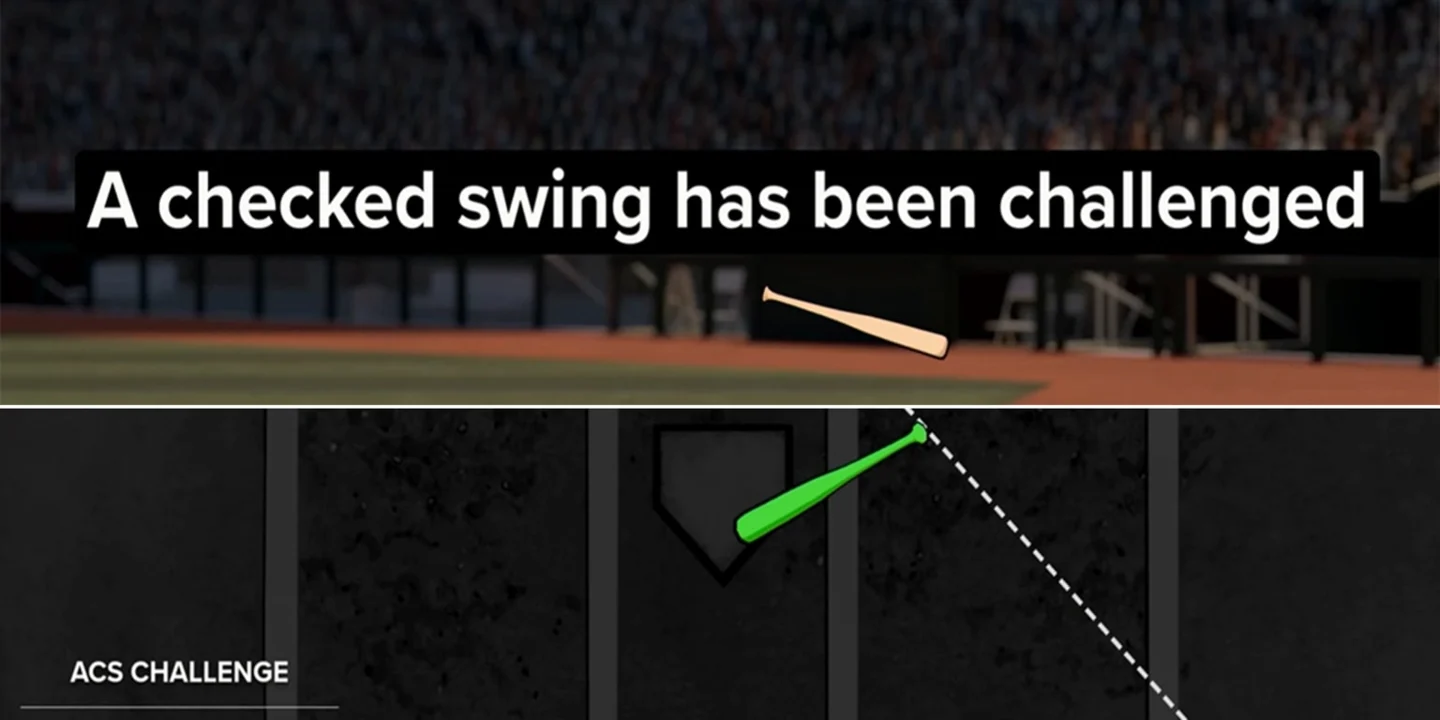
Applying an experimental threshold to a Major League replay can be an interesting comparison. It answers what that particular measurement method might have produced. It does not prove that the on-field crew failed to apply the rule that actually governed the game. The trial's challenge resources and implementation details also should not be copied into an MLB explanation.
A future change would need its own official announcement, scope and effective date. A broadcaster advocating review, a player criticizing a call or a successful minor-league test is evidence of discussion, not confirmation of adoption. When sharing a proposed solution, describe it as a proposal or experiment until the league establishes otherwise.
How to follow the next disputed check swing
Start with four practical questions. What did the plate umpire initially call? Is the disagreement about the batter's offer or the pitch's location? Which procedure, if any, is available for that question? What is the final count and the status of any live runners? Working through those questions prevents several common misunderstandings at once.
If the original call was a ball and the catcher requested help, watch for the base umpire's answer before recording a walk. If the final ruling is a swing, an outside pitch graphic does not create an ABS remedy. If the ruling remains no swing, the separate location question still needs to be assessed under the applicable ABS requirements. If runners moved, keep watching until the play is resolved.
For the next broadcast, use today's MLB games for the current matchup and the MLB TV schedule for viewing details. During the game, the most useful information is the crew's final ruling and explanation. Replays can inform the discussion afterward; the rulebook and the procedures in force determine which decisions the crew can revisit.
Loading comments...