

As of November 10, 2026, Carlos Lagrange and Roderick Arias are two documented Yankees Rule 5 eligibility cases to follow. Their first contracts and signing ages place them in the ordinary five-season window, while the official 40-man roster did not list either player at this check. Eligibility is not a completed selection or a prediction that New York will lose someone. This guide explains the evidence behind that watchlist, the protection decision and the separate questions raised by the winter calendar.
The 2026 eligibility question in plain terms
For a Yankees prospect, Rule 5 eligibility identifies a roster decision the organization may need to make. It does not announce a departure. A player can become eligible, be protected, remain unprotected, be selected or go through the draft without moving. Those outcomes belong in separate columns when you read an offseason list. Treating them as interchangeable turns a routine roster deadline into a misleading prediction about who the Yankees will lose.
The first checkpoint is the official Yankees 40-man roster. At the November 10 check, Carlos Lagrange and Roderick Arias were not listed there, while Elmer Rodriguez and Spencer Jones were. That distinction matters more than a prospect ranking: a ranked player already on the roster is not waiting for this particular protection decision. The two names developed below are a documented watchlist, rather than a claim to reproduce every eligible player in the organization.
The next checkpoint is the transaction itself. A story saying that the Yankees are expected to protect someone is an assessment of a likely decision. A notice that the club selected that player's contract records an action. Neither an impressive spring outing nor a player appearing on a future depth chart substitutes for the latter. The relevant question is whether the player has actually acquired the roster status that provides protection.
Keep the time frame visible as well. The Yankees' current task is managing their own roster. Whether another team would eventually make a selection depends on that team's needs and its willingness to carry the player under the applicable restrictions. A useful watchlist therefore explains both sides of the decision, instead of assigning a percentage to a hypothetical selection without a defensible method.
For fans following several prospects, a small ledger is enough: name, first contract, current roster status, evidence date and announced action. Leave the final column open until an announcement fills it. That approach keeps a November protection discussion useful even if the later winter calendar changes.
Start with a sourced Yankees watchlist
The clearest way to discuss the current question is to show the evidence behind a few names. The following watchlist uses fixed biographical facts and the published eligibility framework. It does not reproduce an official Yankees protection list, and it does not rank every player who could qualify. Current roster status should always be rechecked after the date at the top of this guide.
| Player | Birth date | First Yankees contract | Age then | Eligibility basis |
|---|---|---|---|---|
| Carlos Lagrange, RHP | May 25, 2003 | February 3, 2022 | 18 | Five-season route reaches 2026 |
| Roderick Arias, SS | September 9, 2004 | January 15, 2022 | 17 | Five-season route reaches 2026 |
Carlos Lagrange's first eligibility window
Lagrange's official player transaction history records his first Yankees contract. Combining that date with his birth date establishes the younger signing-age category. Counting the seasons from that first contract explains why a November 2026 protection discussion is relevant. This is a transparent application of the rule, rather than an assertion that MLB published this table as its complete eligible pool.
The baseball decision comes after that administrative check. The organization has to consider the value of retaining a pitcher, his development path and the other players competing for roster space. Fans can make a case for protection without pretending that they know the front office's final choice. The same restraint applies to a future role: adding a pitcher to the roster would not, by itself, announce whether he will start or relieve.
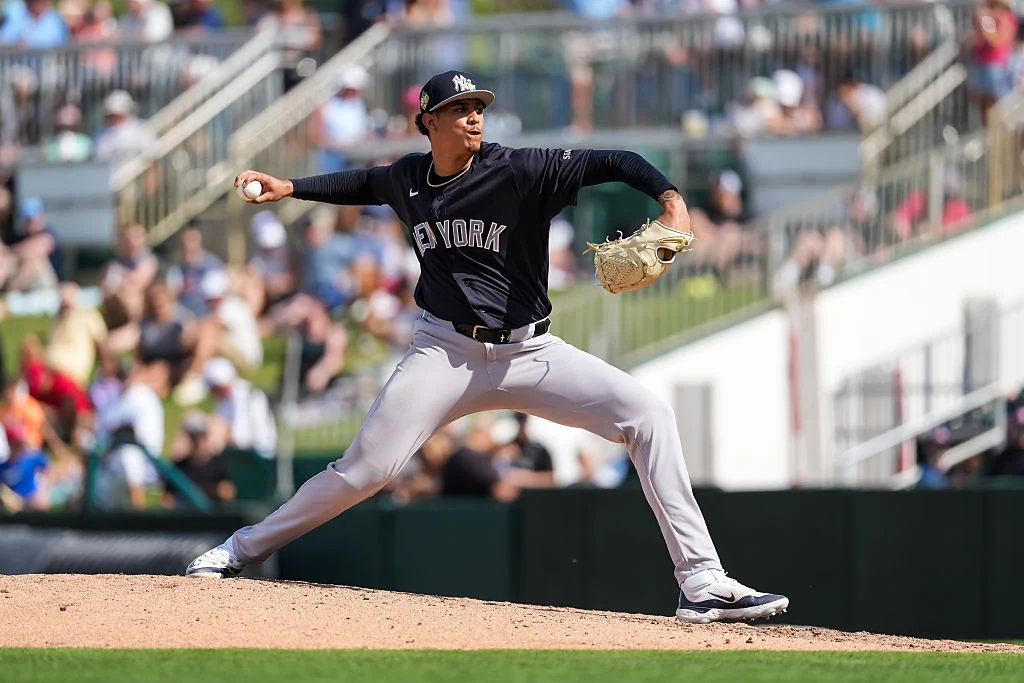
Roderick Arias and the gap between eligibility and readiness
Arias' official transaction history places his first contract in January 2022, when he was seventeen. His eligibility calculation therefore follows the same broad clock as Lagrange's. Their shared window does not make them interchangeable roster cases. A shortstop's possible path to a major league role presents different questions from a pitcher's, even when both need the same administrative protection.
It is useful to separate three judgments: whether a player qualifies for the draft, whether the Yankees should protect him and whether another organization could carry him. Only the first is primarily a rules-and-records question. The latter two require evaluation and remain uncertain until decisions occur. That distinction lets you discuss Arias' case without treating eligibility as a declaration that he is ready for an everyday major league job.
Check signing age and seasons before adding a name
The ordinary eligibility screen starts with the player's first professional contract and his age when he signed. MLB's published framework gives the younger signing category five seasons and the older category four. Applying those clocks to 2026 puts first-time cases signed in 2022 at eighteen or younger, and those signed in 2023 at nineteen or older, on the initial research list. That is a screening tool, not proof that every person from either signing class is exposed.
For the younger route, write out the sequence rather than subtracting years in your head: 2022, 2023, 2024, 2025 and 2026. For the older route, the ordinary sequence begins a year later and still reaches the current winter. MLB's previous draft preview supplies a useful historical example of the same distinction. Its names, dates and draft order belong to that earlier year and should not be pasted into a current Yankees list.
Several tempting shortcuts produce bad lists. Current age does not reveal signing age. A promotion date does not necessarily identify the first contract. A high prospect ranking does not establish whether someone is already protected. A player's current affiliate tells you where he is playing, while the roster record answers a different administrative question. Our guide to the MLB farm system explains why those labels need to be kept separate.
Earlier eligible players also require attention. A list of newly eligible names is narrower than the entire pool that might be available. Conversely, a familiar name can disappear from a watchlist because his roster status changed. Before describing a change as a snub, check whether the underlying list was limited to first-time cases or used a different snapshot date.
When a player's record is complicated, stop at the uncertainty. Confirm the original contract entry and current organization, then look for an official eligibility or protection announcement. It is better to leave one name unresolved than to use a confident-looking table that quietly mixes current candidates, protected players and prospects whose clock has not reached the relevant window.
Protection changes the 40-man roster, not the lineup
A protection announcement answers a contract-roster question before it answers a playing-time question. The organization can add a prospect to its 40-man roster and still plan further development in the minors. Being protected does not promise an Opening Day uniform, a rotation assignment or a place in the everyday batting order. Those decisions draw on performance, health and team needs at a later point.
MLB's options explanation shows why these categories coexist. An optioned player can be outside the active major league roster while remaining on the 40-man roster. That is different from leaving a player outside the protection structure altogether. Fans evaluating a November addition should first ask what status changed, then wait for evidence about the player's assignment.
This also makes a protection decision different from a declaration that an outside acquisition is unnecessary. A club can value a prospect highly while still seeking a veteran at the same position. The relevant comparison involves timing and depth, not simply counting names that appear capable of filling one role. For the separate market question, our 2027 free-agent guide explains why contract options and availability require their own checks.
Account for the place a player occupies
Every protected player occupies a place that must fit into the club's roster accounting. If the roster is full, another move is required to create room. That basic constraint explains why less prominent transactions can appear beside a prospect addition. It does not tell an observer which player the Yankees intend to remove, and it should not be used to invent an imminent trade or designation for assignment.
Use the roster page's own notes before counting vacancies. The Yankees' 40-man tab warns that it can display players on the 60-day injured list even though they are not officially part of that roster. A visible list of names is therefore not automatically a certified number of open places. Read a transaction report and its corresponding move together, rather than calculating roster space from an undated screenshot.
A useful evaluation asks two questions in order: does the transaction fit the applicable roster requirements, and what trade-off does it suggest? The first can often be established from official records. The second is analysis and should be presented as such, especially before the club explains its reasoning.
Why another club might select an unprotected player
The receiving club has to solve a different problem from identifying a promising prospect. It needs a player it can carry under the Major League phase's roster restrictions. That turns the exercise into a question of usable roles as well as future talent. A club may admire a young player's ceiling and still decide that it cannot reserve the required place for him through the coming season.
Under the published Rule 5 framework, a selected player cannot simply be treated like an ordinary minor league depth signing. Removing him from the active roster involves the applicable waiver and return process. Injury status does not create an unlimited development stash, either. These constraints explain why remaining unprotected and actually leaving the organization are different events.
Consider a hypothetical receiving team with an unsettled bullpen. It might find a specific relief role easier to preserve than a daily place for a developing position player. Another club might have the opposite opportunity because its bench needs match that player's skills. These are examples of roster fit, not reports that any particular organization is pursuing Lagrange or Arias. The Yankees' internal evaluation and another club's carrying capacity can lead to different judgments about the same player.
New York has also experienced this issue as the selecting club. The Yankees designated Cade Winquest for assignment in April 2026 after taking him in the previous Rule 5 Draft. That earlier case illustrates how quickly the practical roster decision can become difficult. It does not determine the outcome for a different prospect in a later winter.
When reading a prediction that the Yankees will lose someone, ask what the proposed receiving role actually is. Does the writer explain how a team could use the player, or merely point to a ranking and say the talent is attractive? A strong analysis should address both. Even then, the conclusion remains a forecast until a selection occurs. Leaving a player unprotected creates exposure; it does not force another club to make a pick.
Keep the November decision separate from December uncertainty
Two calendar questions run alongside each other this winter: when clubs must protect eligible prospects and whether later offseason events proceed on their announced schedule. Confusing those questions can make a reader assume that a threatened December disruption removes the need to follow November roster decisions. The safer approach is to track each official checkpoint separately and update it only when the relevant authority announces a change.
Treat the protection date as its own checkpoint
MLB's November 3 roster reporting identifies November 17 as the protection deadline. This guide does not attach an unverified cutoff hour to that date. MLB's separate current offseason guide lists the Rule 5 Draft as scheduled for December 9. A scheduled selection date is different from the earlier decision about which players remain available.
Read the label beside any November deadline carefully. The same offseason guide discusses qualifying offers, contract options and non-tender decisions. A date appearing under one of those headings does not establish the deadline or clock time for another process. It is especially easy to copy a familiar date from a search snippet while losing the sentence that explains what teams or players must actually do.
For the Yankees, the immediate evidence will be additions and corresponding roster transactions. If a later event changes, look for a notice specifying the effects rather than assuming that every earlier roster decision has become meaningless. Protection can remain part of longer-term roster planning even while fans wait for clarity about the next stage.
A bargaining proposal does not rewrite the current draft
MLB's latest published bargaining package discusses changes affecting Rule 5 protection and the treatment of selected players. That material describes proposals. It should not be substituted for an implemented rule when evaluating a current prospect. A headline about a possible shorter protection clock is not evidence that a player has already become newly eligible under it.
For the broader setting, see our CBA and lockout timeline guide. Here, the practical distinction is narrower: use the current published framework, identify future changes as proposals, and revisit the watchlist if an adopted agreement or official draft announcement alters the applicable process. Predictions that an event will be canceled deserve the same separation from an actual cancellation notice.
Follow decisions without confusing projections and transactions
Begin with the year in the headline. A page discussing the previous winter may remain prominent in search results, particularly when it mentions familiar Yankees prospects. Check the publication date and the deadline it describes before using its list. The same care is necessary with a live depth chart: the season in its heading may refer to projected playing time rather than the year of a protection decision.
Next, open the Yankees' official transaction record and identify the action. Selecting a contract, inviting a player to spring training, making a minor league assignment and recalling a player are different entries. Read the complete wording rather than searching only for the player's surname. If the page has not loaded its data, try the relevant month or the player's transaction history; an empty table is not evidence that nothing happened.
Then compare the transaction with the current roster and record the date you checked. A roster page is the state of the club at a point in time, while the transaction log explains how that state changed. Together they provide a stronger answer than either an old prospect list or a social post predicting what management should do. If the records disagree, keep the discrepancy visible until the newer official information resolves it.
- Confirm the first-contract evidence and the applicable signing-age route.
- Check whether the player already occupies a protected roster place.
- Read the announced transaction and any corresponding roster move.
- Follow the eventual playing assignment as a separate development.
For a fan planning to watch a prospect after he reaches New York, use the Yankees schedule once the playing assignment is real. A possible protection decision cannot establish a debut date, and a future schedule cannot establish that a player will be on the club. Keeping those two questions separate avoids turning a useful roster guide into a promise about an appearance that has not been announced.
The most informative update to this watchlist will therefore be a documented status change. Until then, the relevant discussion concerns evidence, roster trade-offs and the distinction between eligibility and an actual selection.
Loading comments...