
MLB playoff games can start during the day because the published postseason broadcast schedule spreads several matchups across different time slots. Time zones also matter: an evening listing in Eastern Time can still mean afternoon baseball at a western ballpark or in your home.
For fans working through an early first pitch, the useful next step is to check the game's current slot, the time zone and any condition attached to it. This guide uses official 2026 scheduling examples reviewed October 10, explains what those announcements establish and helps you plan around a start you cannot watch live.
Several playoff games share the same broadcast day
Look at the whole day's slate before looking only at your team. When multiple series are active, MLB and its broadcast partners publish games in different windows. That arrangement puts some first pitches earlier than a typical fan's after-work viewing time.
The visible scheduling choice is straightforward: spreading starts lets someone follow parts of several matchups. Putting every game into the same evening slot would make those games simultaneous. That is a consequence of the timetable, rather than evidence of a particular private contract or a formula ranking which fans matter most.
Early rounds have more matchups to fit
The completed 2026 Wild Card round offers an example. NBC's published schedule placed September 29 games at 2, 5, 8 and 10 p.m. ET. Those were four separate starting windows, beginning during the workday in the eastern United States.
This is why checking only the evening television guide can miss postseason action. The afternoon game is part of the day's national slate, not an exhibition added outside the playoffs. The playoff format explains how those early series feed the later rounds.
MLB's Division Series announcement likewise scheduled four series to begin on the same Saturday. Several active series mean several games to place, even when each individual fan primarily cares about one of them.
That explains the immediate scheduling issue without promising that every club receives the same mix of slots. To understand your particular day, count the games actually still needed, then read their announced times. A preseason assumption that all October games begin after dinner is not a useful replacement for that list.
Staggered starts do not guarantee zero overlap
A three-hour gap between two starts is not a rule limiting the first game to three hours. An extra-inning game can continue into the next window. A delay can also change how much of the two broadcasts runs at the same time. Staggering first pitches reduces simultaneous starts; it cannot guarantee identical game lengths.
If you want to follow more than one game, choose which matchup takes priority before an overlap develops. Check whether your package includes each channel, and keep a score feed available for the other game. Do not assume that because the first broadcast began earlier, it must finish before the second.
Also distinguish a network's pregame show from the game's listing. A studio program may start before the scheduled action. When adding a reminder, use the game's current start rather than treating every early coverage time as first pitch.
An evening Eastern start can be an afternoon locally
The word afternoon depends on whose clock you are using. An 8 p.m. Eastern listing is 5 p.m. in Los Angeles during October. A fan in New York may think of that as a night game, while a fan watching on the West Coast may still be at work when it starts.
Here are sample conversions for October 2026. They illustrate clock differences; they do not announce start times for particular games.
| Eastern: New York | Central: Chicago | Mountain: Denver | Pacific: Los Angeles |
|---|---|---|---|
| 2 p.m. | 1 p.m. | Noon | 11 a.m. |
| 5 p.m. | 4 p.m. | 3 p.m. | 2 p.m. |
| 8 p.m. | 7 p.m. | 6 p.m. | 5 p.m. |
These cities are observing daylight saving time during that period; NIST's 2026 dates put the U.S. change back to standard time on November 1. Use your actual city and game date when converting, especially if you live elsewhere or are comparing dates across a seasonal clock change.
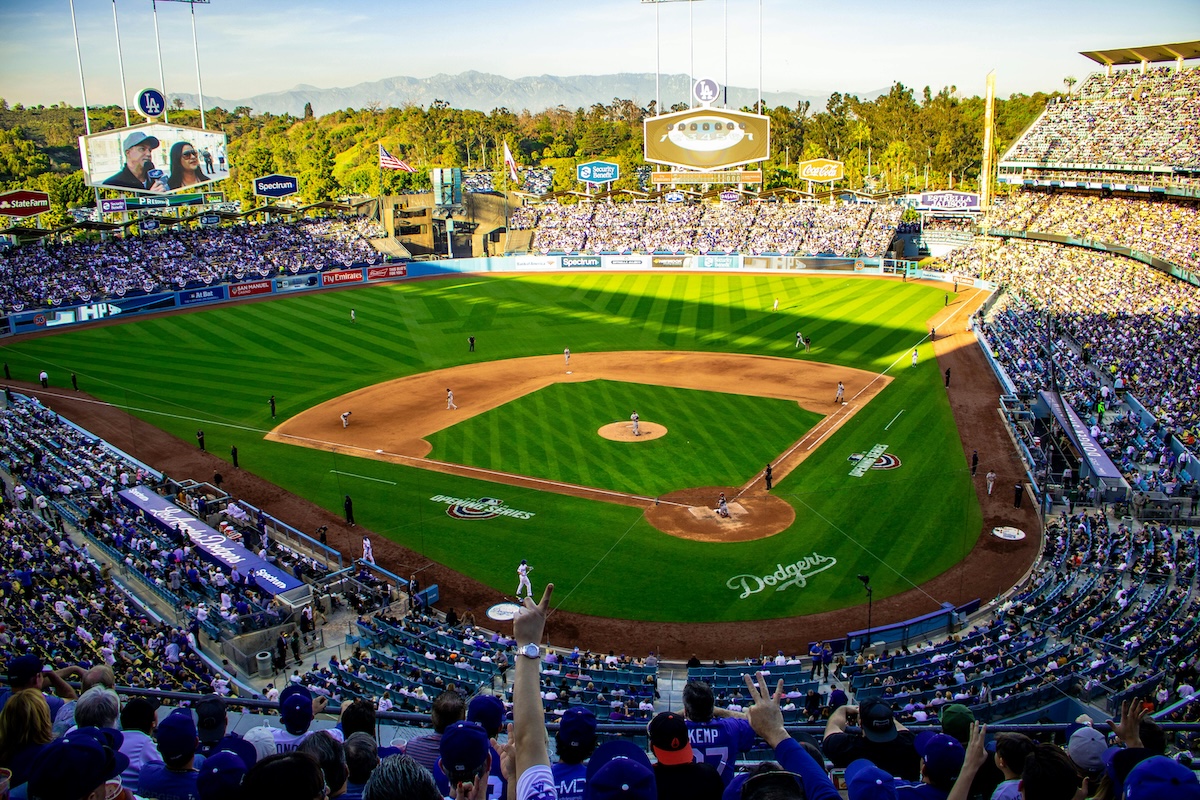
Clock time and visible daylight are also different. A ballpark camera showing sunshine does not establish that MLB assigned an afternoon national television window. The broadcast may be in an evening Eastern slot while the host stadium is farther west. Read the listing before using the lighting in a photo to interpret the schedule.
Read the time zone before adding a reminder
Check whether the page says ET, local time, site time or the time zone you selected. If a schedule has already converted to your chosen zone, subtracting hours again will create a new error. The label is as important as the number.
For a hypothetical 5 p.m. ET game, a Los Angeles viewer should plan around 2 p.m. locally. That is a different afternoon commitment from setting a 5 p.m. reminder on a phone already using Pacific Time. When coordinating with friends in another city, state the zone instead of sending only “five o'clock.”
Use the MLB TV schedule to check the matchup and broadcaster alongside the time. Save the date, time and zone together in your calendar. International fans should also confirm their local date: a U.S. evening broadcast can fall on the next morning elsewhere.
A short check now can prevent a missed first inning even when the underlying schedule has not changed at all. If two pages appear to disagree, compare their time-zone labels before deciding one of them is outdated.
Why a game's start time can move after another series ends
Sometimes the explanation for an early slot appears in a footnote beside the schedule. MLB can announce one time when two games may be needed and a later time when only one remains. The result in another series then affects which version of the timetable applies.
Here is a current 2026 example from MLB's official schedule: October 19 ALCS Game 6 moves from 5 to 8 p.m. ET if there is no NLCS Game 7. That is a stated condition, rather than a rumor about an unannounced schedule change.
The practical reason is visible in the condition: the other series may no longer require its game. You do not need to guess at a network's internal revenue calculation to see why an available evening window changes. The announcement tells you which outcome matters and what the alternative time would be.
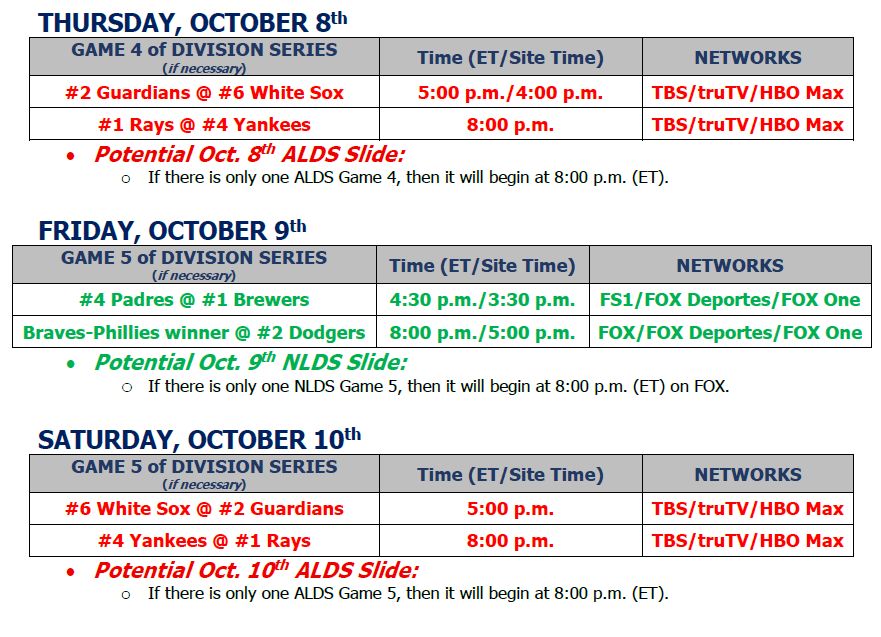
If you saved a game before the condition was settled, revisit the reminder after the relevant series ends. Your old calendar entry may have faithfully recorded the original slot and still need an update. Keep the game date and series number attached so you do not accidentally change a different matchup.
If necessary and TBD mean different things
If necessary concerns whether a game will be played. In a fictional best-of-seven series that ends 4-0, there is no Game 5. An advance listing for that fifth game is a reserved possibility, not a guarantee that fans will have another matchup to watch.
TBD means the information in that column has not yet been determined. It might identify an unknown time or an unknown opponent. Read the column heading before treating it as a time-change condition. A date can be known while a start remains unannounced.
There are therefore two checks: does your game still exist, and has its start time changed? Our 2026 MLB playoff schedule and bracket guide explains the schedule and bracket structure. Check MLB's current official bracket for advancing teams and scores, then recheck the current game listing for first pitch.
For plans with other people, send the updated time with its zone rather than forwarding the first schedule image you saved. A clear “time confirmed” message prevents a conditional afternoon listing from remaining everyone's assumed start after the evening slot becomes available.
Fewer series change the shape of the schedule
The postseason gets narrower as teams are eliminated. The Wild Card round and Division Series each have four series. The LCS stage has two. The World Series has one matchup. That changing number of active series changes how many games can share a date.
Compare rounds before assuming an afternoon start is unusual for a particular team. A four-game early slate presents a different scheduling problem from a night when only one Championship Series game remains. If you compare your club's first-round start with another club's World Series start, you are comparing different timetables.
Fewer series also does not mean every remaining day has the same pattern. One league may have an off day while the other plays. A series can end before its maximum number of games. The relevant count is the games still scheduled for that date, not merely the number of teams that began the round.
For planning, separate a known date from a known hour. MLB's annual postseason announcement scheduled the 2026 World Series opener for October 23. Knowing that date does not let you invent a first-pitch time when the current time field still says TBD.
The 2026 playoff schedule and bracket guide helps connect each round's dates with its path through October. Use it to understand which series a game belongs to, then consult the current game listing for the hour and broadcaster. These are complementary checks.
If you are arranging childcare, a watch party or travel, reserve flexibility around an unconfirmed time. Treat a published start as the best current information and retain any condition attached to it. A remembered start from a previous year, even for the same team in the same round, does not confirm this year's slot.
For fans asking why a later round feels easier to follow, the shrinking slate is a concrete part of the answer. There are fewer simultaneous series to monitor. Your own viewing day still depends on the specific dates, local clock and current announcements.
Weather changes belong to a different category
A published afternoon broadcast window is different from a game moved because of weather. In the first case, the early slot is part of the announced slate. In the second, an interruption or postponement changes plans that were already made.
A historical example shows the distinction: rain moved 2022 Guardians-Yankees ALDS Game 5 from Monday night to Tuesday at 4:07 p.m. ET. MLB's announcement explicitly identified the postponement. That afternoon makeup was not simply the original evening game continuing on its old timetable.
Read the status message carefully. A delay can leave viewers waiting for an update. A postponement requires a revised schedule. A suspended game is completed later from the point where play stopped. None of those labels should be inferred solely from a television guide that has not refreshed.
For a current game, consult the individual announcement from MLB or the clubs before leaving home or changing a recording. Check the new date as well as the hour, and confirm which broadcast will carry the rescheduled action. An old screenshot can be accurate for its publication time while no longer answering today's question.
If you have tickets, read the host club's instructions for that specific situation. A postponed game's broadcast listing does not by itself explain ticket entry, gates or exchanges. Keep those attendance details separate from the time you intend to watch at home.
The MLB games today page provides a quick place to check the day's matchups and status. Pair it with the official announcement when a disruption occurs. This avoids applying a conditional television footnote to a rain delay, or assuming a normal day game must have been moved for weather.
Plan around first pitch when you cannot watch live
Once the start is confirmed, choose how you want to follow it. Trying to solve an afternoon clash five minutes before first pitch can lead to a rushed subscription purchase or an incomplete recording. A little preparation lets you keep the option that best fits your day.
Start with the access you already have. Confirm the game, channel, time zone and device, then decide whether you can watch live, listen, follow updates or save the game for later. You may prefer different options for different games in the same series.
Follow the game in audio or live updates
ESPN's 2026 postseason radio announcement confirms national audio coverage of every game, with audio available on the ESPN App and ESPN.com. That is an audio route; it does not establish that ESPN carries each live television broadcast.
If listening fits your situation, open the correct feed before the start and test the sound. If only occasional score checks fit, keep the game's inning and live status visible alongside its score. That makes a quick break more useful than reading a headline that may describe a rally already completed.
You can also choose to join the broadcast later. When returning, note how far the game has progressed rather than assuming it began at the hour shown in an old reminder. If several games are underway, check the matchup carefully before opening a feed.
Choose a replay or recording before the game starts
A recording and an on-demand replay are different ways to watch later. The recording depends on your provider's setup and access to the carrying channel. A replay depends on the rights holder making that completed game available to your account.
For example, YouTube TV's recording instructions tell viewers to add the team or event to their library. If you add a program while it is in progress, the recording starts from that point. Anyone using that service should set it up before the game, rather than expecting a late selection to reconstruct every pitch already missed.
MLB's current postseason archive information states a 90-minute wait after the game for full archives with a valid MLB.TV subscription. Check the actual replay in your account. The full-game replay guide explains the options and the difference from short highlights.
If you want to experience the result fresh, adjust score notifications before the game and avoid opening a live standings page on the way to the replay. If you only want the decisive moments, a highlight clip may suit you better than saving the entire broadcast.
Your useful checklist is simple: confirm the current local start, check any schedule condition, verify the viewing or listening route and prepare the later-viewing option before first pitch. That turns an inconvenient afternoon slot into a plan you can actually use.
Loading comments...