
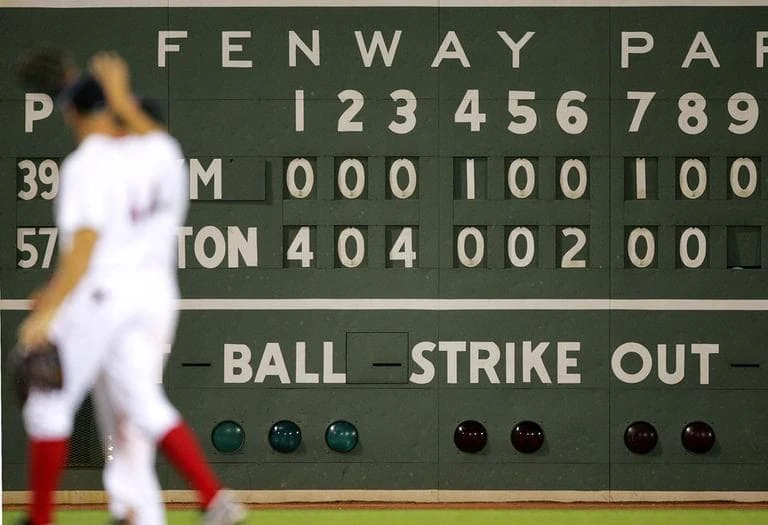
Read an MLB box score in this order: game status and line score, batting table, pitching table, then the game notes. Keep at-bats separate from plate appearances, pitching outs separate from decimal arithmetic, and individual totals separate from team accounting. Those distinctions explain many of the apparent contradictions in a finished record.
This is a reading guide rather than a live results feed. Its worked examples are hypothetical. Use the official record for a particular game, and check the competition and date before comparing the numbers shown by different services.
Start with the game identity and line score
Before reading a player's numbers, confirm the teams, date and game status. Doubleheaders produce two separate box scores for the same opponents on the same day. A resumed game can also require more context than the date on which you happen to open it. Use the current MLB game listings to find the contest, then check the date and game number inside its record.
The line score is the inning-by-inning run summary, usually with the visiting team above the home team. Its final columns commonly show R, H and E: runs scored, hits recorded and errors charged. Runs determine who is ahead. Hits measure a different part of the offense, while errors describe defensive scoring decisions. A club can win despite having fewer hits.
Read those totals as a compact result, then use the player tables and notes to explain it. A hypothetical line of four runs, seven hits and one error does not tell you whether the runs came from a homer, several walks or a late rally. It gives you the first questions to investigate. Neither does an error total reveal every defensive mistake that a viewer might have noticed.
A zero, a blank and an X mean different things
A zero normally records a completed scoreless half-inning. An empty future cell is not another scoreless inning: play has not necessarily reached it. Display conventions differ, so compare the inning indicator and status rather than treating every unfilled box as a numerical zero.
An X commonly marks a home half-inning that was not needed. If the home club leads four to three after the visitors finish the ninth, it does not bat again merely to fill the grid. That is different from a walk-off, where the home team starts its final turn and scores the winning run. A final result can therefore be legitimate without both rows containing nine completed numerical entries.
Always resolve the status first. A three-run lead in the sixth is a live situation, not a final outcome. A delayed or suspended label also requires its own reading; a populated statistical table alone does not prove that the contest has ended.
Read the batting table without confusing opportunities and hits
The batting block follows the players' offensive contributions. AB means official at-bats, H means hits, R means runs scored, RBI means runs batted in, BB means walks, and SO or K commonly means strikeouts. Read each label against its own definition. A player can help create a run without receiving a hit, and a batter's run total does not tell you how many teammates he drove home.
The key distinction is between an at-bat and a plate appearance. A walk adds a completed turn at the plate without adding an official AB. Other outcomes also receive special treatment, so AB is not a universal count of opportunities. MLB's at-bat definition is the starting point when a batting line looks shorter than the sequence you watched.
Work through a hitter's line
Imagine a hitter who singles, walks, strikes out and grounds out in four completed turns. These are hypothetical results, not a current player's box score.
| Field | Value | Explanation |
|---|---|---|
| AB | 3 | The walk does not count as an at-bat |
| H | 1 | Only the single is a hit |
| BB | 1 | One walk |
| SO | 1 | One strikeout among the two outs |
| PA | 4 | The four completed turns in this example |
His batting average for this game would be one divided by three, or .333. That does not mean every AVG cell displayed beside a game line is a single-game figure. A service may show a season rate alongside today's counting statistics. Check the column's time scope before trying to reproduce it from one evening's numbers.
If this hitter later crosses home plate, he receives a run scored. Whether he earns an RBI is a separate question about a run he helped drive in. Do not transfer the same number automatically from one column to the other. The table summarizes recorded outcomes, not a complete ranking of offensive value.
Track substitutes within the batting order
Indented or grouped names often show replacements who shared a batting slot. PH identifies a pinch-hitting role and PR a pinch-running role. A substitute listed below a starter does not give the team another place in the offensive sequence. Read the grouping alongside the game's substitution record.
A late defensive replacement can also appear without a completed batting turn. His presence in the record does not establish an omitted hit or an error in the table. To understand when each player entered, compare the box score with the play-by-play rather than trying to reconstruct every move from indentation alone.
Translate the pitching line into outs and responsibility
Many letters reappear in the pitching block with the viewpoint reversed. H means hits allowed, BB means walks issued, and SO or K means strikeouts recorded. They are not additional batting totals for the pitcher. Begin with the number of outs he recorded, then examine baserunners and runs before interpreting the result beside his name.
Innings notation is not a decimal
MLB's innings-pitched definition counts three outs per full inning. In the familiar box-score notation, 5.1 means five innings and one out; 5.2 means five innings and two outs. The digit after the point is an outs indicator, not a decimal fraction.
| Displayed IP | Recorded outs | How to read it |
|---|---|---|
| 0.1 | 1 | One out |
| 5.0 | 15 | Five full innings |
| 5.2 | 17 | Five innings plus two outs |
| 6.0 | 18 | Six full innings |
For example, adding a reliever's one out to a starter's 5.2 produces six innings, written 6.0. Ordinary decimal addition would produce 5.3, which is not the correct innings notation. Convert to outs first when checking whether several pitching lines account for the completed defensive innings.
A 0.0 entry can still represent an appearance. A pitcher who faces a batter and allows a walk without recording an out has done something in the game even though his outs total remains zero. Read the surrounding columns before mistaking that line for a player who never entered.
Runs and earned runs answer different questions
R identifies runs charged to the pitcher; ER identifies the portion classified as earned. Error-related scoring requires the scorer to evaluate the inning, so an error anywhere in the sequence does not automatically erase every later run from earned-run accounting. Use the official classification rather than making a blanket adjustment yourself.
Responsibility can also survive a pitching change. In a simple hypothetical, a starter leaves a runner on first and a reliever allows a double that brings him home. That runner does not automatically become the reliever's charged run merely because a new pitcher was on the mound when he scored. Check the inherited-runner context before judging the two lines.
ERA is a rate, not another count of tonight's runs. Two earned runs across six full innings correspond to a 3.00 earned-run rate over that span. A season ERA displayed beside the appearance includes a broader record, so it need not match a calculation using this game alone.
Read pitcher decisions without ranking the performances
The W, L and SV labels record pitching decisions under scoring rules. They are not a separate vote on who looked best. A starter can work seven innings, allow one earned run and still lose if his team supplies no runs. Another pitcher can receive a win after a much shorter appearance because of when the decisive lead changed hands.
For a normal game scheduled for nine innings or longer, a starter needs at least five innings to qualify for a win. Consider a hypothetical starter removed after four innings with his club ahead. Even if the team never loses that lead, he does not automatically receive the win. Relief-pitcher credit then depends on the applicable scoring rules. The winning club and its starting pitcher do not have to share the same win result.
The losing decision similarly follows responsibility for the decisive run and the lead sequence. It is not awarded by selecting the pitcher with the most hits allowed or the highest ERA on the page. When a late rally makes the decision confusing, find the run that put the winning club ahead to stay, then read the pitching and baserunner context around it.
A save is conditional, too. Recording the final out of a victory does not by itself guarantee SV beside the reliever's name. The requirements concern the game situation and the qualifying appearance. Our separate guide to MLB saves and multi-inning relief explains those cases in more detail; the box score tells you which decision was actually recorded.
Finally, inspect the scope of any record printed beside the name. A figure such as 12-6 may describe that pitcher's cumulative wins and losses for the competition shown. It is not the game's final score, his innings total or a promise about the next start. Postseason and regular-season records may be displayed separately.
Use decisions to identify the official result, and use the rest of the line to evaluate the outing. Outs, baserunners, charged runs and the situation inherited by a reliever provide the context that a lone W or L cannot supply.
Use team totals and notes to reconstruct the game
The notes below the player tables often explain what the main columns cannot. Extra-base hits, double plays, stolen bases and runners left on base identify events worth finding in the play-by-play. Read them alongside the inning in which the score changed, rather than treating the final hit total as a complete account of the offense.
Two clubs can reach the same run total through very different sequences. One might cluster several hits in an inning; another might score in separate innings. A box score compresses those outcomes. A detailed scorecard or play log restores the order in which they occurred, which is essential when you want to understand a rally or a missed opportunity.
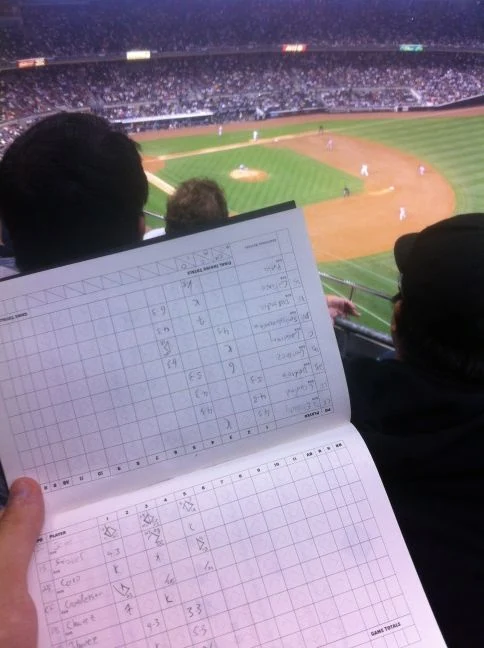
Individual LOB does not add up like team LOB
The MLB explanation of left on base distinguishes batter and team accounting. They answer different questions, so adding the individual LOB column is not a reliable way to check the team's total.
Imagine one runner standing on first while the next three hitters strike out. Each batter has failed to bring that runner home, but the club has stranded one person when the inning ends. The same runner can therefore be represented in several individual entries without becoming several different runners in the team count. A difference between the two totals is not automatically a data error.
Use LOB as an invitation to look at the situations, not as a complete diagnosis. A high number does not identify which opportunity was most promising, whether a strong defensive play ended it or what the hitter could reasonably have done differently. The sequence and game state supply that context.
The same reading habit applies elsewhere in the notes: identify the recorded event, locate its inning and compare it with the scoring progression. You will learn more from one specific sequence than from attaching a broad label such as "clutch" or "wasteful" to every player based on a single total.
Check live updates, final results and scoring corrections
During play, the box score is a changing record. An entry can appear before every related total has refreshed, and a pitching line can change after an inherited runner scores. Compare the inning and update context before deciding that two displays contradict one another. For the surrounding game events, the Gameday and play-by-play guide explains how the live tracker complements the tables.
Afterward, "Final" tells you that the game has ended; it does not promise that every statistical judgment will remain untouched. MLB maintains an official scoring-changes record for later revisions. A hit-versus-error change can alter a player's statistical line without changing the number of runs his team scored.
When an old screenshot differs from the current official record, identify the specific field that changed. A hit, RBI, error or earned-run adjustment is different from a correction to the displayed game status. Do not assume that a revised individual statistic means the winner has changed. Conversely, do not declare every disagreement a scoring revision before confirming that both pages refer to the same contest.
Extra innings can produce another unfamiliar combination of totals. Before drawing a conclusion about a runner, an earned run or the absence of a conventional hit sequence, check which rules applied to that competition. Our postseason extra-innings explanation separates October's setup from the regular-season automatic-runner format. A rule from one setting should not be silently imported into another.
A reliable reading routine is short enough to use after any game:
- Match the date, opponents, game number and live or final status.
- Read the line score, then the batting and pitching blocks from their own viewpoints.
- Convert pitching notation to outs and keep individual statistics separate from team accounting.
- Use game notes, play-by-play and the latest official record to resolve the remaining questions.
MLB Schedule is an independent companion for finding games and understanding their records. This tutorial explains the numbers; the official game record remains the source for a particular result and any later scoring decision.
Loading comments...