
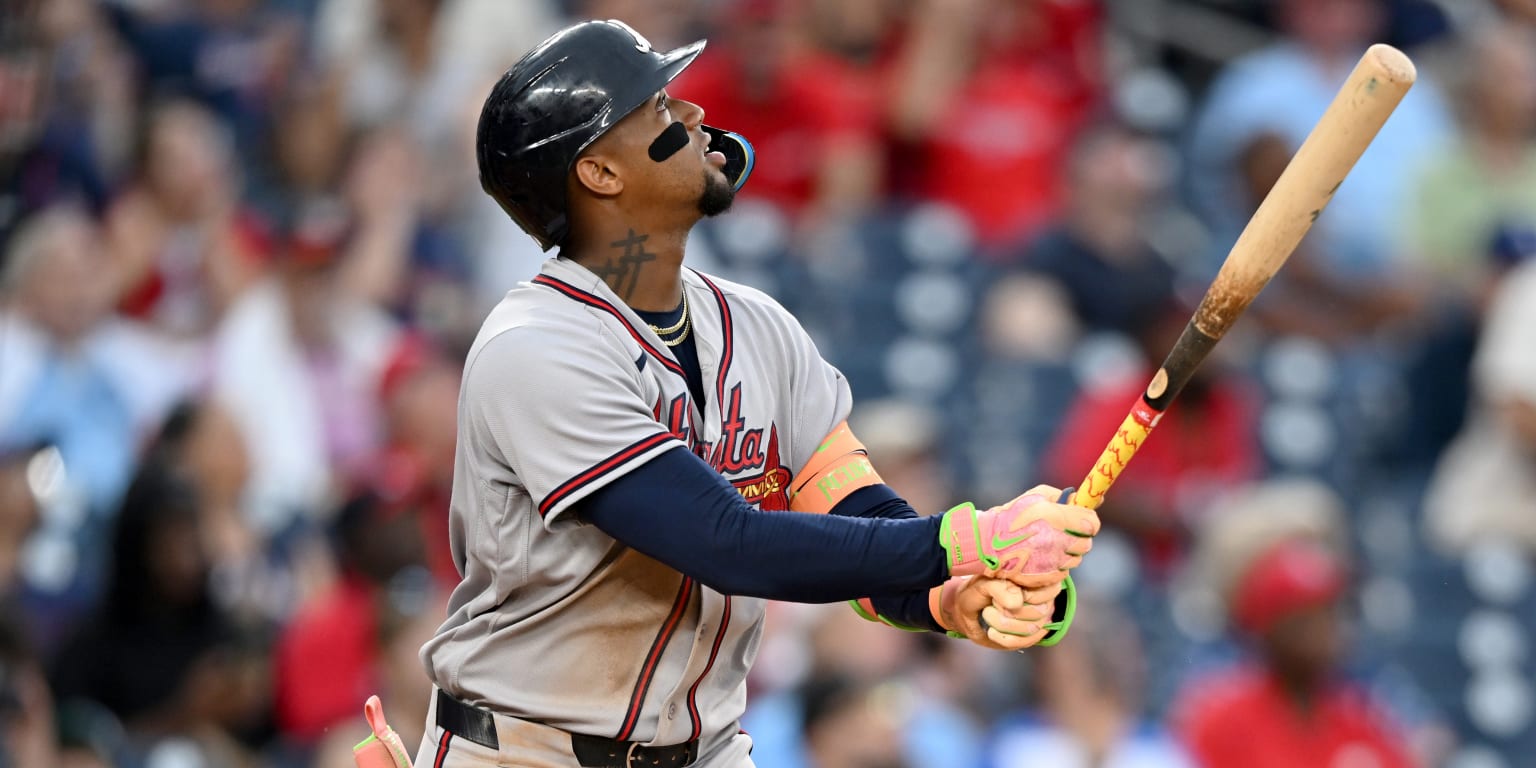
Ronald Acuña Jr. became the fastest player in Major League Baseball history to reach both 200 career home runs and 200 career stolen bases on September 2, 2026. The Atlanta Braves star arrived at the combined threshold in his 904th regular-season game, beating Alfonso Soriano’s previous pace by 25 games. Acuña already had more than 200 steals; it was his 200th home run, a three-run shot against Washington Nationals reliever Max Kranick, that completed the pairing.
The record needs one careful qualifier. “Fastest” here means the fewest career games required for a player to own at least 200 homers and 200 steals. It does not automatically mean youngest by age, shortest time since a debut, or the first player to produce both totals in one season. Those are different statistical questions. Using the right definition makes Acuña’s achievement more impressive, not less: through the milestone game, he had accumulated 200 home runs and 225 steals despite two major knee injuries interrupting his career.
This guide freezes its numerical snapshot at the end of Atlanta’s 9-0 win in Washington on September 2. It explains the milestone plate appearance, shows the official fastest-to-200–200 comparison, connects the record to Acuña’s unprecedented 2023 season, and addresses the rules-era question that follows almost every modern stolen-base achievement. It also separates reachable arithmetic checkpoints from predictions. Acuña’s totals can change with his next game; the historical fact that he became the first player to reach both marks within 904 games cannot.
How Ronald Acuña Jr. Reached 200–200 in Washington
Acuña’s milestone afternoon at Nationals Park contained both halves of his signature. He singled twice and stole second for career steal No. 225 before his seventh-inning plate appearance. With two runners aboard and Atlanta leading 3-0, Nationals right-hander Max Kranick opened with a fastball near the top of the strike zone. Acuña attacked the first pitch and drove it to left, where it landed along the visitors’ bullpen walkway. Statcast projected the home run at 379 feet.
The three-run homer extended the Braves’ lead to 6-0 and ended a longer wait than the final swing suggests. Acuña had hit career homer No. 199 on August 15, then went 16 games without another. MLB reported that he batted .207 with a .292 on-base percentage and a .241 slugging percentage across the 15 games before the finale. The milestone was therefore not the product of a player cruising through a hot streak. It arrived after a visible stall, on a pitch type he had recently found difficult to handle.
He finished 3-for-5, and Atlanta finished the day with a 9-0 win. The home run was Acuña’s 14th of an injury-interrupted 2026 season. More importantly for the record, it was career No. 200. Because he had recorded stolen base No. 200 on June 24, 2025, the homer was the last requirement for entry into the 200–200 group.
The order of events gave the game a fitting shape. Acuña did not merely reach a career power-speed milestone while standing still on an old stolen-base total; he added another steal before supplying the homer. One play required reading the pitcher, accelerating and beating a throw. The other required recognizing a hittable fastball and converting it into damage. The two skills rarely coexist at elite volume, which is exactly why the 904-game comparison is meaningful.
What “Fastest to 200 Home Runs and 200 Stolen Bases” Means
The calculation uses one clean finish line: the first career game after which a player has at least 200 home runs and at least 200 stolen bases. A player may cross one threshold much earlier. The clock keeps running until the other number also reaches 200. Acuña entered September 2 with 199 home runs and 224 steals, so game No. 904 became his entry point when the seventh-inning drive cleared the fence.
| Rank | Player | Career game reaching 200 HR and 200 SB | Games behind Acuña |
|---|---|---|---|
| 1 | Ronald Acuña Jr. | 904 | — |
| 2 | Alfonso Soriano | 929 | 25 |
| 3 | Eric Davis | 1,053 | 149 |
| 4 | Bobby Bonds | 1,065 | 161 |
| 5 | Sammy Sosa | 1,094 | 190 |
| 5 | Barry Bonds | 1,094 | 190 |
MLB’s comparison shows Acuña first and Soriano second, followed by Eric Davis, Bobby Bonds, Sammy Sosa and Barry Bonds. The “games behind” column is simple subtraction from 904; it helps show that the record is not a marginal tie-breaker. Acuña created a 25-game gap over the previous standard and reached the combination 149 games sooner than the next player after Soriano.
This is not a list of the six highest career totals, nor a ranking of complete careers. It says nothing by itself about postseason production, defense, longevity or peak value. It also is not an age ranking. A player can debut younger, miss more calendar time or play a different number of team games and still be evaluated consistently here because only his own appearances enter the denominator.
The record is now fixed for Acuña at 904. His future home runs and steals will increase the totals but cannot move the first date on which he possessed both 200s. The leaderboard itself can change if another player gets there in 903 games or fewer. That distinction matters when comparing this durable career checkpoint with the moving tables in our 2026 MLB records and leaders guide.
Acuña’s Path Included Two ACL Recoveries
The compact 904-game denominator can hide how much calendar time Acuña lost. On July 10, 2021, he tore the anterior cruciate ligament in his right knee while pursuing a fly ball in Miami. The injury ended his season after 82 games and kept him out during Atlanta’s championship run. He returned to the Braves on April 28, 2022, nearly 10 months after the surgery, and gradually rebuilt toward his historic 2023 peak.
A second major interruption followed on May 26, 2024. This time Acuña tore the ACL in his left knee while moving between second and third in Pittsburgh. He missed the remainder of 2024, underwent another long rehabilitation and did not return to Atlanta’s lineup until May 23, 2025. MLB described the second recovery as more conservative than the first. In his comeback game, 362 days after the injury, he homered on the first pitch he saw.
Those absences should be interpreted carefully. They do not add games to the record calculation, because the leaderboard counts a player’s career appearances rather than his club’s schedule or days since debut. In that narrow sense, the injuries did not inflate the 904-game number. Yet they plainly interrupted the repetition, timing and physical continuity that power hitting and aggressive baserunning demand. Reaching the threshold after rebuilding two knees is part of the human context even though it is not a statistical adjustment.
The record also should not be repackaged as proof of durability. It describes production per games played, not availability across every season. Both ideas can be true: Acuña reached the power-speed intersection faster than anyone in MLB history, and his route included long periods when he could not play at all. Recognizing both prevents the milestone from becoming a misleading all-purpose verdict on his career.
For the next appearance rather than the historical timeline, use the Atlanta Braves schedule. Lineups and availability can change on game day, so a career article should not promise that Acuña will start a specific future game. The injury history explains the path to No. 200; it is not a medical forecast.
Why the 2023 40–70 Season Is Central to the Story
A career 200–200 mark rewards sustained dual production, but Acuña had already demonstrated how far he could push the same pairing within one season. In 2023, he became the first player in MLB history to record at least 40 home runs and 70 stolen bases in a season. He finished with 41 homers and an MLB-leading 73 steals, turning two round-number goals that had never coexisted into one final line.
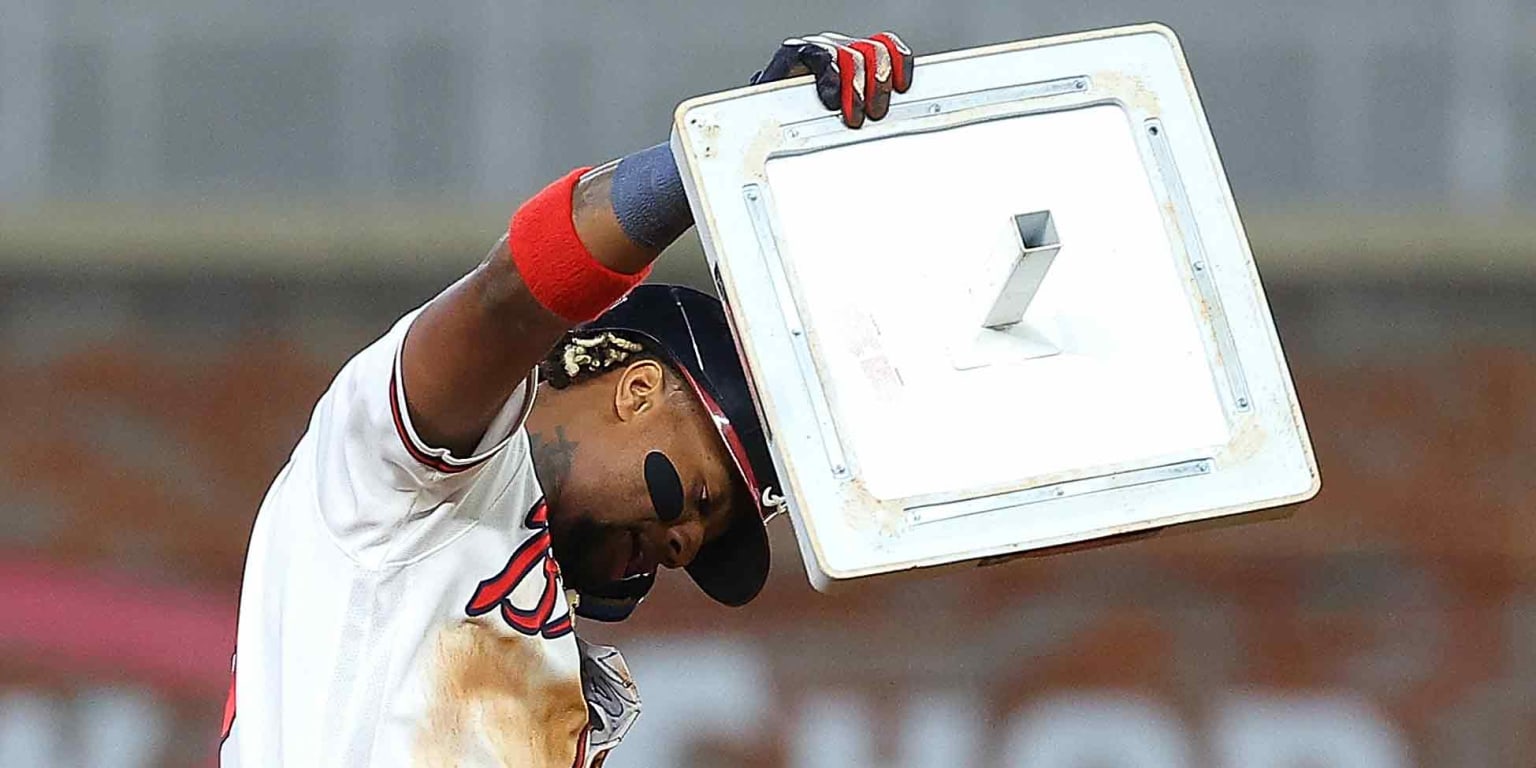
The season was not a two-stat novelty. Acuña also led MLB with 217 hits and 149 runs, posted a .416 on-base percentage and a 1.012 OPS, and collected 383 total bases. He played 159 games from the leadoff spot, repeatedly creating an immediate scoring problem: pitch carefully and risk putting an elite runner on first, or challenge a hitter capable of starting a game with an extra-base hit.
That complete offensive case earned him all 30 first-place votes for the 2023 National League Most Valuable Player Award. It also brought the NL Hank Aaron Award. The unanimous MVP result matters to the 200–200 story because it shows that the power-speed totals were not treated as empty accumulation. They were the most visible parts of a season in which his ability to reach base, hit for damage, run and score drove one of baseball’s strongest offenses.
The 73 steals also accelerated the career milestone dramatically. One exceptional running season cannot supply 200 steals by itself, but adding more than one-third of the threshold in a single year shortens the path. At the same time, 41 home runs kept the power side moving instead of forcing a tradeoff. Many players can run frequently while producing modest power, and many sluggers have little reason to risk outs on the bases. Acuña’s record rests on refusing that conventional specialization.
There is a useful difference between the two accomplishments. The 40–70 season is a peak: an unprecedented burst within one schedule. The 200–200 record is a pace: the fewest games needed to accumulate two career totals. Together they answer complementary questions. The first shows the highest single-season expression of Acuña’s skill mix; the second shows how efficiently that mix accumulated from his debut through September 2026.
How Acuña’s 904-Game Pace Compares with the Record Chasers Behind Him
Alfonso Soriano is the most direct comparison because his previous standard was only 25 games away. Soriano’s 2006 season for Washington—46 home runs and 41 stolen bases—shows the same rare ability to maintain top-end power while running often. He ultimately hit 412 career homers, and his 929-game arrival at 200–200 remained the pace record until Acuña’s swing in the same city two decades later.
The rest of the leaderboard demonstrates that there is no single template. Eric Davis produced 37 homers and 50 steals in only 129 games in 1987, one of the sharpest single-season power-speed peaks ever. Bobby Bonds and Barry Bonds each recorded five 30–30 seasons, while Soriano had four. Sammy Sosa reached the career intersection in the same number of games as Barry Bonds, even though their broader career shapes were not identical.
That variety exposes the logic of the threshold. The slower category controls the finish. A player with 250 home runs and 199 steals has not reached 200–200; neither has a player with 250 steals and 199 home runs. Extra production on the completed side does not transfer to the unfinished side. Acuña had already banked 25 excess steals when homer No. 200 arrived, while another player’s decisive event could be a stolen base.
The 25-game advantage over Soriano is meaningful because the denominator is already compact. It represents roughly one month of everyday appearances, not a rounding error over a 2,500-game career. The much larger gap to Davis—149 games—shows how distinctly Acuña and Soriano separated from the rest of MLB’s listed fastest six.
None of this makes the table an automatic ranking of the six players. Career length, league environment, defensive contribution, postseason record and peak offensive value remain outside its scope. The comparison isolates a fascinating question and answers it precisely: who accumulated these two counting-stat thresholds with the fewest opportunities to play? On September 2, 2026, that answer became Acuña.
How the 2023 Rule Changes Affect Cross-Era Comparisons
Any fair discussion of Acuña’s stolen bases must include the environment introduced in 2023. MLB enlarged first, second and third base from 15-inch squares to 18-inch squares. That reduced the distance from first to second and second to third by 4.5 inches. The pitch-timer system also limited a pitcher to two disengagements—pickoff attempts or step-offs—during a plate appearance before an unsuccessful additional attempt would produce a balk, unless the defense recorded an out.
Those changes were designed partly to restore action on the bases, and the early evidence showed an effect. Through May 11, 2023, MLB teams were attempting 1.8 steals per game, the highest rate in 11 years, while succeeding on 78.3 percent of attempts, then the highest rate in league history. Larger targets, slightly shorter distances and a more predictable limit on pitcher actions all improved the runner’s conditions.
It is therefore reasonable to say that Acuña’s 73-steal season occurred in a friendlier running environment than the immediately preceding years. It is not reasonable to stop the analysis there. Every major-league runner played under the same 2023 framework, yet MLB noted that none of the 13 other hitters with at least 35 home runs stole more than 21 bases. The rules expanded opportunity; Acuña converted that opportunity at a scale unmatched by the other leading power hitters.
The career record also spans more than one rules period. Acuña debuted in 2018 and accumulated part of his 225-steal total before the larger bases and disengagement limit arrived. Soriano, Davis, Sosa and both Bonds played under other strategic and run-scoring environments. No single adjustment can translate every attempt, injury, lineup role and managerial decision into a perfectly neutral number.
That limitation is common to cross-era baseball records. The useful approach is to preserve both truths: conditions matter, and performance within those conditions still distinguishes players. The 904-game record does not prove Acuña would have reached the thresholds in exactly 904 games in 1987 or 2006. It records what he accomplished in the MLB games he actually played, just as the comparison entries record what earlier players accomplished under theirs.
What Power-Speed Milestones Could Come Next?
From the September 2 snapshot of 200 home runs and 225 stolen bases, the next symmetrical round-number checkpoint is 250–250. Acuña would need 50 additional homers and 25 additional steals to hold both totals. The uneven distances matter: he is already halfway from 200 to 250 on the stolen-base side, while the full 50-homer interval remains.
A 300–300 checkpoint is much farther away. From the same frozen totals, it would require 100 more home runs and 75 more stolen bases. That arithmetic is exact, but it is not a timetable. Dividing the remaining totals by a career or single-season rate would produce only a rough scenario, not a scheduled milestone date.
Power-speed countdowns also do not move in lockstep. A homer and a steal can occur in the same game, as Acuña’s 225th steal and 200th homer nearly did within the Washington finale’s broader story. They can also arrive in long clusters separated by droughts. Team needs, batting order, score, pitcher delivery times, health and risk tolerance all influence stolen-base chances independently from home-run opportunities.
The most honest way to follow a future chase is to keep two columns and update completed games. Once Acuña has at least 250 in each category, the relevant game becomes fixed just as game No. 904 is fixed for 200–200. Until then, “on pace” language should include a cutoff date and should never be mistaken for an accomplishment already secured.
There is no need to force a grander forecast onto the present record. Reaching 200–200 faster than Soriano, Davis, Bobby Bonds, Sosa and Barry Bonds is already a complete historical result. Future thresholds can add to it; failing to reach a speculative number would not retroactively weaken what happened in Washington.
How to Follow Acuña and the Braves After Home Run No. 200
A career total is easiest to follow when the game information and the statistic come from separate, appropriate checks. Start with the MLB games today page to identify Atlanta’s matchup, game status and scheduled start. Do not copy an old first-pitch time from a milestone story: schedules, weather and national selections can change.
Once the game begins, use a live box score or Gameday feed to track Acuña’s plate appearances and baserunning. A home run should appear in the scoring summary and his batting line; a stolen base should appear in the play record and box score. Our MLB Gameday play-by-play guide explains how to read the count, runners, pitch sequence and completed-play descriptions without confusing a live update with an official final.
For video, check the current MLB TV schedule after finding the game. The listed broadcaster is more useful than assuming every Braves game appears on the same service. MLB.TV is primarily an out-of-market product, and home-territory or national restrictions may apply. A subscription name alone does not guarantee that one particular live telecast is available at your location.
- Before the game: confirm the date, opponent, start time and game status.
- During the game: use the official scoring feed for each plate appearance, home run and stolen-base ruling.
- After the game: wait for the final box score, then update both career columns from the official player page.
That workflow protects against the most common errors in a milestone chase: counting a replay as a new event, treating an advance on an error as a steal, using a postponed game as an appearance, or updating one total but not the other. It also preserves the cutoff used throughout this article. The numbers were 200 home runs and 225 stolen bases after September 2, 2026; later totals belong to later completed games.
Home run No. 200 settled the record question decisively. Acuña needed 904 games to own both 200s, 25 fewer than Soriano. Everything after that belongs to the next chapter, but fans do not need a projection to appreciate the one that has already entered MLB history.
Loading comments...