

To check an MLB starting lineup, match the exact game, look for an announced rather than projected order, and recheck for late changes. Then read each player's batting slot separately from his defensive position and handedness. That small sequence answers most of the confusion behind a search for "Lineup MLB."
This guide explains how to interpret and verify an order. It does not publish a live list of starters. For the names attached to a particular game, use the club's announcement or MLB's starting-lineups page, checking the selected date and any subsequent updates.
Find the right game before reading a lineup
Start with the matchup, not the first nine names returned by a search. A useful lineup check begins with the team, opponent, game date and game number. Open today's MLB schedule to identify the contest you intend to follow, then compare those details with the lineup page. A correct order attached to the wrong game is still the wrong answer for your evening.
The date deserves particular attention when you follow baseball from another time zone. A late game in the United States can fall on the next calendar day where you live. A search engine can also retain a previous date in its title or send you to a page whose selector has not advanced. Check the date displayed inside the page, rather than treating the word "today" in a search result as verification.
Doubleheaders make the opponent check insufficient. The same clubs can play twice on the same date, with different starting pitchers and different batting orders. A catcher might start one game and sit the other. A screenshot that says only the two team names may therefore omit the detail you need most: whether it belongs to the opener or the second game. Keep the game number attached when sharing a lineup.
Weather changes can create another mismatch. A familiar start time in an older post does not establish that the matchup is still scheduled exactly as announced. Return to the current game listing after a postponement or a schedule adjustment, and follow the lineup associated with that contest. Do not assume an earlier card carries over unchanged.
A quick identity check is more useful than collecting several versions of the same graphic. Before comparing names, ask:
- Does the date inside the page match the game I want?
- Are the opponent and home or away designation correct?
- Is this the right game of a doubleheader?
- Does the listing show a scheduled game, a delay, a postponement or a completed result?
Those checks narrow the problem before you decide whether the order itself has been confirmed.
Tell a projected order from a confirmed lineup
The most important label is the one describing the order's status. A projected lineup estimates who will start; a confirmed lineup reports a starting order that has been announced. Read that label before interpreting an individual player's placement. Nine neatly arranged names can look authoritative even when the publisher is still making an educated guess.
Treat a projection as a forecast
A projection can help you anticipate a matchup, but it should remain a planning aid. Yesterday's starters, a familiar platoon pattern or an expected rest day may suggest an order without establishing today's selection. If an expected left fielder is replaced by a reserve in the later announcement, the earlier estimate was not necessarily a reporting error. It may simply have been an estimate that was never updated in the screenshot you saved.
A depth chart answers a different question again: who generally occupies a position and who can provide cover there? It does not establish the batting order for one particular contest. Likewise, a player can be on the available roster without appearing among the starters. Treat those documents as background until you find the actual game-specific announcement.
Different services can use different badges, colors or abbreviations. Read the legend on the page you are using instead of importing a meaning from another app. The useful question is whether that publisher describes the names as expected or as announced, and whether it has updated the entry since a later change.
Know what confirmation does and does not mean
A public "confirmed" badge is not the official game card itself. MLB's published rules identify the umpire's retained card as the official batting order. That formal procedure is separate from the timing of a team's social post or a data service's status update.
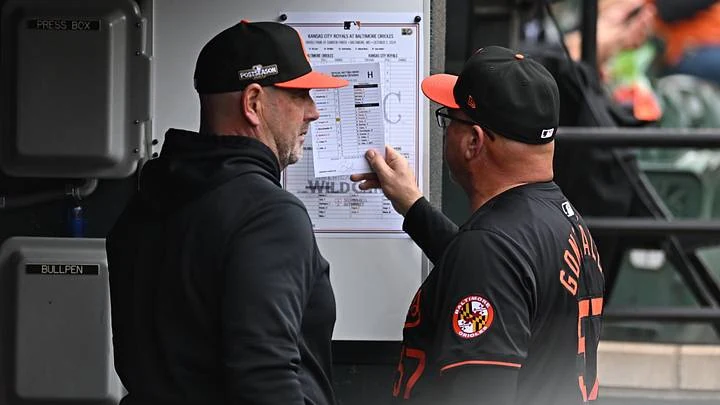
For a fan, confirmation is the stronger starting point, followed by a fresh check close to the game. It does not promise that every named player will complete nine innings or rule out a subsequent announced scratch. Neither does the absence of an early announcement prove that the club has forgotten to submit its lineup. Public distribution and the administration of the game serve different purposes.
There is no need to turn an approximate publishing habit into a deadline. If a third-party guide says lineups usually arrive a couple of hours before first pitch, use that as a convenient reminder to check again. Do not treat it as a universal MLB rule or proof that every missing order is late.
Read batting slots, positions and handedness separately
A lineup graphic often puts several codes beside the same name. They describe different things. The number at the start of a batting-order row indicates when that hitter comes up. A position label indicates his starting assignment. A uniform number identifies the player. None of those fields can safely substitute for another.
| Field | What it tells you | Common mistake |
|---|---|---|
| Batting slot, first through ninth | The hitter's place in the offensive sequence | Reading it as a defensive position |
| Position, such as SS or RF | The assigned defensive position at the start | Assuming the position determines the batting slot |
| Uniform number | The number worn by the player | Treating it as a batting-order number |
| Bats: L, R or S | Left-handed, right-handed or switch-hitting | Confusing batting side with throwing arm |
| Throws: L or R | The player's throwing hand | Assuming it must match his batting side |
For example, a player batting fourth can be a shortstop wearing almost any available uniform number. In scorekeeping, shortstop has the defensive code six; that does not move him to sixth in the batting order. The numerical systems answer different questions. Read the column heading whenever an app displays numbers without the familiar position abbreviations.
A switch-hitter's designation describes his ability to bat from either side. It is not a promise of a favorable matchup in every plate appearance. A pitching change can alter the matchup you expected before the game, while a player's actual approach may have its own nuances. Keep the label separate from a prediction about performance.
Why the designated hitter changes the head count
In the usual designated-hitter setup, nine offensive slots appear alongside a separately listed starting pitcher. The DH bats in the pitcher's place without taking a defensive position. Seeing another name beside the nine hitters therefore does not mean the club has created a tenth batting slot.
Read the hitter list and pitcher panel as connected information, rather than trying to force both into one numbered column. The MLB designated-hitter explanation provides the basic role; specialized two-way-player or substitution cases need their own rule check. For an ordinary pregame scan, identify the nine batting slots, the DH label and the pitcher assigned to open the game.
Understand what the batting order can tell you
The order organizes opportunity. Earlier slots come around before later slots, so the top of the order generally receives more turns over time. That matters when you compare two possible roles for the same player. It does not mean that a promotion to second guarantees another hit, an RBI or even a particular number of appearances that evening.
Consider a hypothetical game in which the offense completes its final turn with the fifth hitter. Some players above that point in the order have had an additional chance compared with teammates below it. That is an opportunity difference, not a measurement of how well they used it. A hitter can have a productive night with fewer appearances, while another can go hitless despite receiving more chances.
Do not turn the traditional labels into selection rules. A leadoff hitter does not have to be the fastest player, and the best hitter does not have to bat third. MLB's analysis of modern batting-order construction describes the growing emphasis on giving strong hitters earlier opportunities. The useful lesson is to read the actual order, rather than replacing it in your mind with the arrangement you expected.
A move down the order can be worth following, but one card rarely explains the whole decision. The opposing pitcher, another player's return, a defensive assignment and the manager's available bench can all be relevant questions to investigate. Treat them as questions until a report or announcement answers them. The lineup alone does not explain why the manager made every selection or prove that a player's long-term role has disappeared.
For the same reason, a new name is not automatically a newly added roster member. An existing reserve can start without any transaction. A genuine promotion brings separate roster context, discussed in our guide to MLB call-ups and active-roster rules. Identify whether you are seeing a daily choice, a substitution or a formal roster change before interpreting the news.
Use several games and verified reporting when assessing a trend. A single higher batting slot is a fact about one lineup; a sustained change in role requires a longer record. This distinction keeps a useful pregame clue from becoming an unsupported prediction.
Handle late scratches and in-game substitutions
A starting lineup describes a starting arrangement. Following the game still requires noticing changes. Before first pitch, a late scratch can produce a revised order; after play begins, a substitution changes who occupies a batting slot. Save both the original announcement and the later update only if their timestamps remain attached, so an older version does not circulate as the latest one.
A missing starter is not automatically injured
An absent name does not establish the reason for the absence. Rest, a matchup decision, an availability issue or an injury can produce similar-looking lineup changes. Only reporting or a club announcement can tell you which explanation applies. A blank row or a player's omission is not enough to diagnose an injury or predict a return date.
MLB's reporting offers a useful reminder that scratches have different causes: its April 2026 report about Carter Jensen concerned a late arrival. That historical example does not explain another player's absence. It simply shows why the word "scratched" should lead you to the stated reason rather than to an automatic medical assumption.
When a replacement is announced, check the revised batting slot and defensive assignment together. The new starter may occupy the same position without receiving the same place in the order. Read the updated whole card instead of replacing one name mentally and assuming everything else stayed identical.
Follow the batting slot after a replacement
Once the game is underway, an ordinary substitute inherits the outgoing player's batting slot. A player removed from an MLB game cannot re-enter. The league's substitution guide explains that basic framework; specialized designated-hitter cases can require additional rules.
For a hypothetical example, suppose a pinch-hitter enters for the seventh batter. The next trip through the order does not create a new tenth position: the replacement now occupies that seventh slot. If a defender subsequently moves from left field to right field while remaining in the game, the defensive move alone does not send him to a different batting slot.
This is why a pregame graphic cannot answer every question in the sixth inning. Open the Gameday and play-by-play guide when you need to follow replacements. Compare the starting card with the substitution entries and current box score. More than nine names in a finished batting table usually reflect players sharing slots over the course of the game, rather than an expanded batting order.
Use a short pregame verification routine
You do not need a different app for every part of the check. Begin with the exact game, find an announced order from the club or an official game source, read the status and update information, then return once more before first pitch. That sequence is easier to repeat than comparing a collection of screenshots whose publication times are unclear.
- Match the opponent, date and doubleheader game number.
- Identify whether the order is projected or reported as confirmed.
- Read the batting slot, position and handedness as separate fields.
- Look for a later club announcement or replacement notice.
- After play begins, follow substitutions rather than relying only on the original nine.
MLB Schedule is an independent companion for finding games and understanding what the listings mean. A lineup guide does not issue the club's official announcement. When a player-specific question remains, use the relevant team announcement or official game record to resolve it. Keep the publisher and timestamp attached if you forward that information to someone else.
Resolve an empty or conflicting lineup page
An empty panel has several possible explanations. The selected date may have no game, the page may still be pointing to another date, or a scheduled game's batting order may not yet have been published. Check the schedule and date control first. Do not conclude that every player is unavailable, or that the service has failed, from an empty batting table alone.
If two sources disagree, compare their game identities and update times before counting how many sites show each version. Several copies of one early graphic do not outweigh a later verified replacement announcement. Reopen the official game listing, inspect the club's newer information and make sure the conflicting entry does not belong to the other half of a doubleheader.
Finally, keep lineup information separate from viewing access. An announced order tells you who is expected to start; it does not grant a live video stream. Once your game and its participants are clear, use the MLB TV schedule to check how that matchup is carried. You can then follow the broadcast or game tracker with the correct order and a clear understanding of what might still change.
Loading comments...