
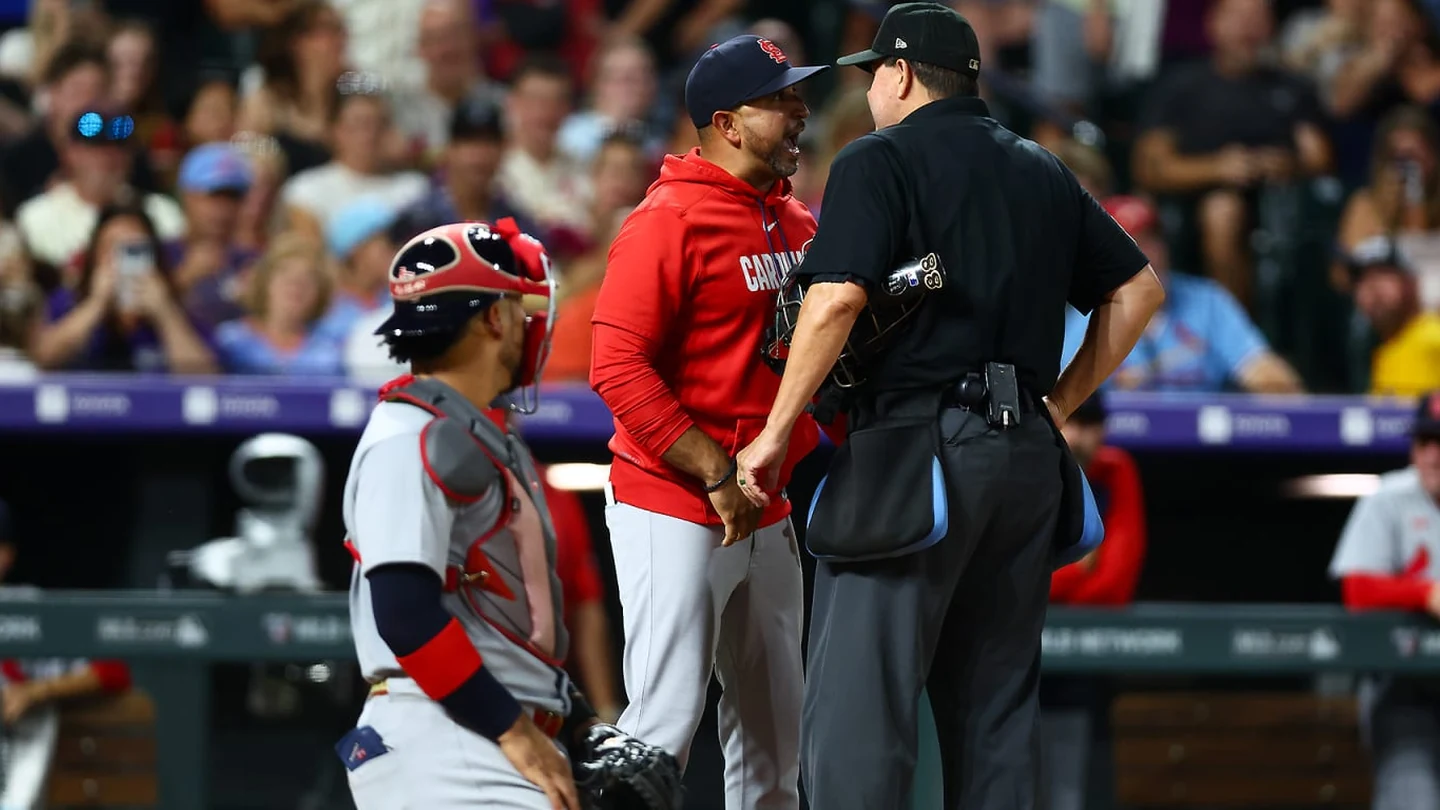
Updated September 20, 2026: Cardinals rookie Hancel Rincon was not cited for breaking a written cap-angle rule. Home-plate umpire Doug Eddings directed him to straighten his tilted hat during his MLB debut on September 4, manager Oliver Marmol was ejected later in the inning, and players from St. Louis and Colorado answered the next night by wearing their own caps at an angle. MLB was subsequently reported to have told Eddings that he went too far, and Eddings approached Rincon with an apology. The sources reviewed for this article do not establish a public fine or suspension.
The details matter because several versions of the story circulated at once. The chronology below separates video-supported and on-the-record facts from a disputed claim about who first raised the hat, then explains why an ordinary piece of baseball style became a league-wide argument about authority, respect and unwritten rules.
What Happened During Hancel Rincon’s MLB Debut
The incident began on Friday, September 4, at Coors Field, where St. Louis opened a series against Colorado. Rincon, a 24-year-old right-hander from the Dominican Republic, entered in the bottom of the sixth with the Cardinals ahead 4-1. It was the first major league appearance of a professional career that began when he signed with St. Louis in 2019. Fans looking for the club’s remaining games can follow the Cardinals schedule, but the important point for this episode is that Rincon was stepping onto an MLB mound for the first time.
The Sixth-Inning Directive
Rincon wore his cap with the bill angled to his left, as he had while pitching before his promotion. Home-plate umpire and crew chief Doug Eddings stopped play and had catcher Leo Bernal tell the rookie to straighten it. Rincon complied. He did not stage a protest, refuse an order or argue with the umpire.
Speaking after the game through an interpreter, Rincon said he had no idea why he had been told to adjust the cap and added that the exchange did not distract him. That distinction is essential. His inning went badly—he recorded one out while allowing three hits and three earned runs—but neither Rincon nor the available evidence established that the cap conversation caused those results. A rough debut and an umpire’s unusual instruction happened in the same inning; treating one as the proven cause of the other would go beyond the facts.
Rincon began by retiring Hunter Goodman on a liner to second. TJ Rumfield then tripled, Cole Carrigg hit an inside-the-park home run, and Connor Norby singled. Manager Oliver Marmol called for Justin Bruihl to finish the inning. By then the Cardinals’ three-run lead was gone, and a small exchange about a cap had become part of a tense pitching change.
Marmol’s Ejection Happened Later
Some social summaries compressed the story into “umpire orders hat change, manager is immediately ejected.” MLB’s game account shows a longer sequence. Marmol continued talking with Eddings after Rincon was removed. During that exchange, Bruihl was assessed a pitch-clock violation, the argument continued, and Eddings ejected Marmol. It was Marmol’s fourth ejection of the season.
Marmol also drew a line between two issues. He said he was not arguing the replay review of Rumfield’s triple. His problem was what he described as Eddings telling a debuting pitcher that the young player was not going to wear his hat that way on the umpire’s field. Marmol called the directive a “power-hungry move” and cited pitchers such as Dontrelle Willis, CC Sabathia and Pedro Strop, all known for wearing caps at an angle.
The Cardinals ultimately won 7-6 after Iván Herrera’s three-run homer in the ninth. That result is easy to lose in the viral clip, yet it helps keep the event in proportion: this was an unusual officiating dispute inside a real comeback game. The controversy grew because of the explanation afterward and the players’ response the next day, not because the hat itself decided the score.
Was Rincon Breaking an MLB Uniform Rule?
No published rule reviewed for this incident requires a pitcher’s cap bill to point straight ahead. That answer is narrower than saying an umpire can never address clothing or equipment. Umpires do have responsibilities when something creates a safety issue, violates an equipment provision or distracts a hitter. The dispute was whether the ordinary angle of Rincon’s team-issued cap met any such standard.
What Official Baseball Rule 3.03 Covers
Official Baseball Rule 3.03 governs player uniforms. It requires teammates’ uniforms to be consistent in color, trim and style; regulates visible undershirts and sleeves; and restricts certain additions or reflective features. Among its specific distraction provisions, a uniform may not carry a pattern that imitates the shape of a baseball, and players may not use glass buttons or polished metal. Separate rules regulate colors and distracting patterns on a pitcher’s glove.
Those provisions show that baseball’s rule book does take visual distraction seriously. They also show why Rincon’s case was different: Rule 3.03 does not say that every cap bill must be centered, and reports from the game did not identify a prohibited color, reflective material, foreign substance or baseball-like pattern. CBS Sports reached the same conclusion after reviewing the rule, while MLB’s own game report recorded Eddings acknowledging that Rincon had not broken a written rule.
A cap is part of the uniform, so game officials are not powerless if it creates a genuine problem. But “an umpire can address distractions” and “a tilted bill automatically violates Rule 3.03” are two different claims. The first describes judgment in context. The second would need text that the published rule does not contain.
Eddings Called It an “Unwritten Rule”
In his postgame explanation, Eddings said directly that the cap angle was not a rule. He characterized it as a small “unwritten rule” and said that, if something on the field is distracting and someone alerts an umpire, the umpire may address it. That explanation shifted the story away from a straightforward equipment violation and toward a judgment call about appearance and etiquette.
Baseball uses the phrase “unwritten rules” for shared customs that are not codified in the Official Baseball Rules. They can influence how players perceive conduct, but they are not the same as a violation with a published definition and prescribed consequence. The long history of pitchers wearing caps off-center made this particular custom especially difficult to defend as uniform practice. Marmol’s examples—Willis, Sabathia and Strop—were reminders that fans have repeatedly seen the style tolerated.
That history does not mean every visual complaint must be ignored. It does mean enforcement needs a clear baseball reason and consistent treatment. When a veteran official imposes an appearance preference on a rookie during his debut, then describes it as unwritten, players are likely to see the act as personal discretion rather than neutral rule enforcement. That gap between authority and explanation drove much of the backlash.
The Disputed Claim About a Rockies Batter
A second controversy formed after Eddings explained why he had acted. His account included a question from a Colorado batter, but early reports and social posts moved too quickly from “a batter” to one named player. The available record does not support treating that identity as settled.
What Eddings Told Reporters
Eddings said after the game that a batter asked whether Rincon could wear his hat that way. He said he did not initially know the answer, thought the cap was very crooked and asked the catcher to tell Rincon to straighten it. In MLB’s primary report, Eddings did not publicly name the batter.
Because Goodman was the first hitter Rincon faced, reporters initially connected Eddings’ description to that plate appearance. MLB.com later clarified that video shows the exchange among Eddings, Bernal and Rincon did not happen during Goodman’s at-bat. That timing does not establish who, if anyone, spoke later in the inning. It does show why the first identification should not have been repeated as a confirmed fact.
The careful formulation is therefore limited: Eddings said a batter asked a question; his public account as reported by MLB did not identify that batter; and the available video timing undercut the early assumption that it was Goodman. No reviewed source conclusively names a different Rockies hitter. Fans should resist filling that gap with a guess.
Why Hunter Goodman’s Denial Matters
Goodman responded forcefully the next day. He said he never mentioned Rincon’s hat, did not care how a pitcher wore a cap and had been focused on seeing the ball. He also said he was receiving online criticism for something he had not said. Rockies manager Warren Schaeffer backed his player and sought an explanation from Eddings; according to Schaeffer, the umpire said that he had not named Goodman.
This is more than a side dispute. A loosely attributed comment turned an officiating controversy into abuse aimed at a player who denied involvement, while the updated video sequence made the initial identification less plausible. The responsible conclusion is to remove Goodman from the role of confirmed complainant. His denial is on the record, and no public evidence reviewed here disproves it.
There is still an unresolved question about what Eddings heard and from whom. It may have been another batter, a misunderstood remark or a description that became imprecise after the game. None of those possibilities is established. Reporting uncertainty is not evasive; it is the only accurate response when the accounts do not fully align.
How Players Turned the Hat Into a Protest
The response on Saturday, September 5, required no press release. Players changed the angle of their caps and let the visual joke carry the message. It was playful enough for a ballpark and clear enough that viewers understood it as support for Rincon and criticism of the previous night’s directive.
Cardinals Tilted Caps and Batting Helmets
Most Cardinals players wore their caps to one side during pregame warmups, according to the Associated Press account carried by ESPN. Many kept the look in the dugout during the game. Some players even angled their batting helmets during on-base celebrations, extending the gesture from warmups into visible game moments. Coaches and fans joined as well.
The display worked because it was coordinated without interfering with play. No one needed to manufacture a confrontation with the umpiring crew. A clubhouse took the same style that had been singled out on a rookie and made it collective. Marmol said he loved that his players consistently had one another’s backs, while starter Matthew Liberatore described the team’s ability to unify as its defining strength.
Rockies Players Joined the Gesture
The show of support was not limited to the visiting dugout. Reports said at least some Colorado players also wore their caps to the side. The careful phrase is “some”: neither MLB nor the AP account said the full roster participated. Fans following the teams after the series can use the Rockies schedule and the Cardinals page rather than relying on old social clips for current game information.
Cross-team participation changed the tone. This was not simply St. Louis complaining because its manager had been ejected. Colorado players could signal that they saw the hat instruction as excessive while still competing to win. Their involvement also fit Goodman’s on-record position that he did not care how an opposing pitcher wore his cap.
Rincon’s Response Kept the Focus on the Team
Rincon did not escalate the story. With help from interpreter and bullpen catcher Kleininger Teran, he said he felt significant support from his teammates and that the group would be better when it stayed together. He also kept returning to the personal milestone: reaching the major leagues was his dream, and an awkward debut night did not erase it.
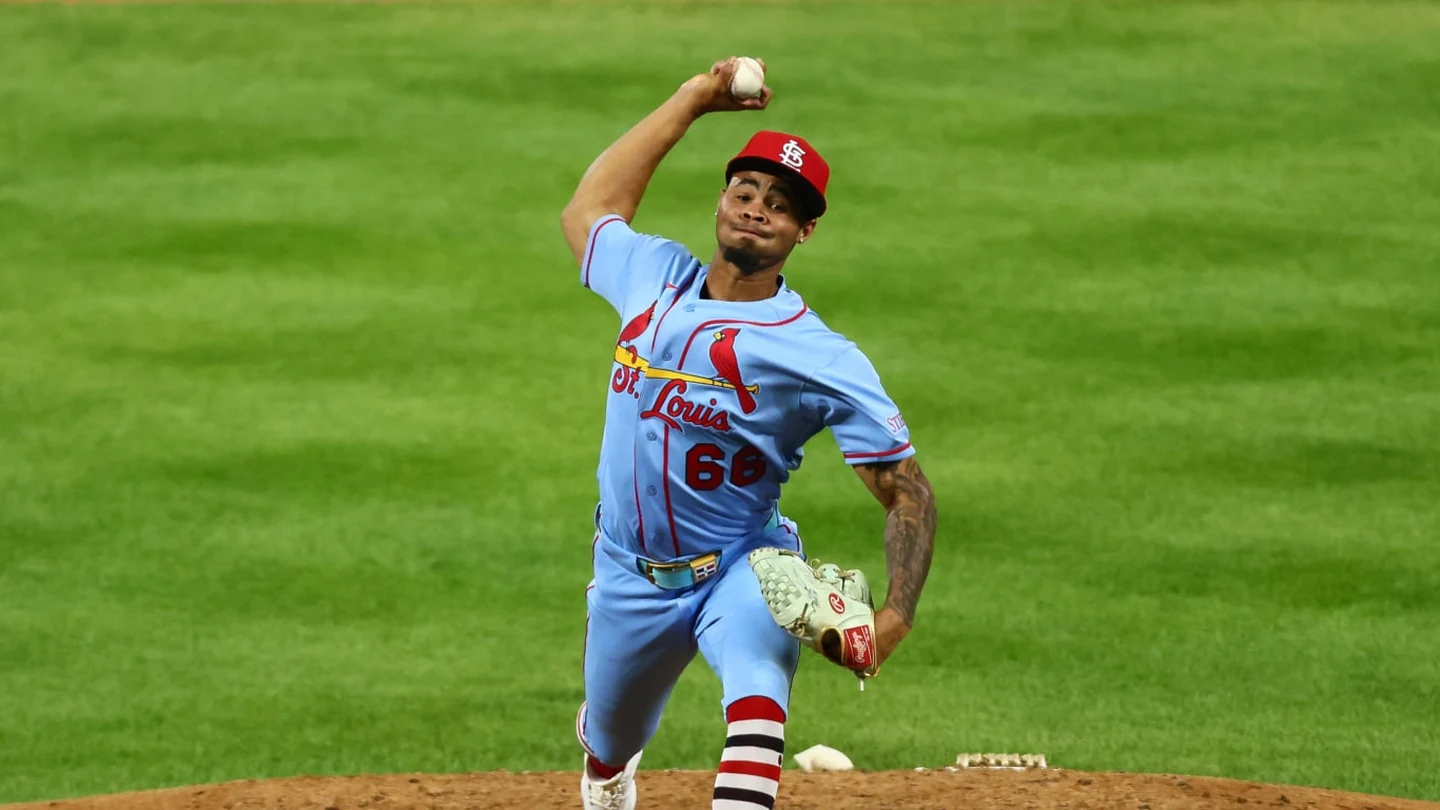
Rincon returned to the mound Saturday. He worked a clean sixth inning and recorded his first major league strikeout before struggling in the seventh. The appearance again had mixed results, but it let the baseball story continue beyond the viral argument. Teammates could defend his right to be himself while he focused on the next hitter and the next opportunity.
That balance explains why the gesture resonated with fans. The tilted caps were funny and instantly readable, yet the purpose was protective rather than performative: teammates made sure the youngest person at the center of the episode did not stand alone.
What MLB Did About Doug Eddings
This part of the story needs precise verbs. There is reliable reporting that MLB spoke to Eddings and regarded his action as inappropriate. There is also a confirmed on-field apology. Those facts do not amount to a public announcement that the league fined, suspended or fired him.
The Reported League Message
The Athletic’s Ken Rosenthal reported that Major League Baseball communicated to Eddings that he had acted inappropriately the previous night. Citing two people briefed on the matter, the report said the league believed the veteran umpire went too far when he admonished Rincon. It also noted that umpires can use broad discretion when they believe a player’s conduct or equipment is distracting.
That is meaningful league handling: according to the report, MLB reviewed the incident quickly and told the official that this use of discretion exceeded the proper boundary. But it remains sourced reporting about an internal conversation. MLB did not publish a disciplinary release laying out a charge and penalty, and the people who described the communication were not named because they were not authorized to discuss it publicly.
Viral posts went further, including a claim that Eddings had been suspended for the rest of the 2026 season and postseason. No MLB announcement or reliable report reviewed as of September 20 substantiated that punishment. “MLB reportedly told him he went too far” is supported. “MLB suspended him” is not.
Eddings’ Apology and Its Limits
Before Saturday’s game, Eddings spoke with both managers. Then, as pitchers moved toward the bullpens during the middle of the first inning, he stopped Rincon for a short conversation. Rincon later described the meeting as cordial and said it appeared that Eddings apologized and wished him good luck for the rest of his major league career. Rincon said he answered that it was not personal and that everything would stay there.
The exchange had an obvious limitation: Eddings spoke to Rincon without an interpreter, and Rincon said he understood only a couple of words. The rookie could recognize the apparent apology and intent, but the conversation did not produce a detailed, mutually translated public account. Eddings was not made available to reporters after the Saturday game. An MLB spokesperson’s comment was brief: the gesture on the field spoke for itself.
An apology can close the personal conflict without settling every public question. It did not identify the batter Eddings said had spoken, explain why an unwritten expectation was enforced in that moment or create a published cap policy for future games. It did show Eddings approaching the rookie directly, and Rincon accepted the gesture without seeking a longer feud.
The defensible status is therefore straightforward: MLB was reported to have corrected Eddings internally; Eddings apologized on the field; Rincon accepted what he understood as an apology; and no public fine or suspension had been established by the reviewed sources as of this article’s update. Any stronger claim needs new evidence.
Why the Incident Became Bigger Than a Crooked Cap
If the same instruction had been tied to a clear safety problem or written equipment violation, it probably would have disappeared within an inning. Instead, a veteran crew chief interrupted a rookie’s debut to enforce a standard he later described as unwritten. That combination made the exchange a debate about who receives discretion and who is asked to conform.
A Rookie’s Debut and the Power Imbalance
Rincon arrived with almost no major league power. He was 24, had just been selected from Triple-A Memphis and needed an interpreter for detailed interviews. Eddings was an experienced crew chief controlling the game. Rincon’s immediate compliance was sensible; challenging the directive on the mound could have made the moment harder. Marmol had the institutional standing to push back, so he did.
That context explains why teammates described their response as protection. They were not claiming that every inconvenience ruins a debut. They were saying that the least established player should not be singled out for a harmless style choice that veteran stars had long made. Former Cardinals pitcher Kyle Gibson and multiple media commentators later criticized the intervention, adding to the reaction, but those opinions remain reactions—not proof of a separate violation or formal punishment.
The language gap also deserves care. Rincon could communicate through an interpreter after the game, but the instruction came through his catcher and the later apology occurred without translation. That circumstance may have limited nuance. It does not, by itself, prove discriminatory intent, and responsible coverage should not assign a motive unsupported by evidence. It does show why clarity and restraint matter when an official addresses a player in a vulnerable, high-pressure first appearance.
Baseball Style, Precedent and Unwritten Rules
Caps have always carried personality. Some players curve the bill sharply; others leave it flat; some pitchers angle it to one side. Marmol invoked Willis, Sabathia and Strop because their looks are familiar to baseball audiences. Those examples are not legal precedents that bind an umpire, but they make sudden selective enforcement look arbitrary.
“Unwritten rule” can describe a custom, an etiquette expectation or simply a veteran’s preference. The phrase becomes troublesome when it is enforced like a formal rule but cannot be found in the rule book. Players cannot predict a standard that changes with the official or the identity of the player. Fans cannot evaluate a penalty if the prohibited conduct has no stable definition.
The players’ answer exposed that weakness. By tilting many caps at once, they demonstrated that the style itself did not stop a game from functioning. They also converted an individual correction into a consistency test: if the look was truly unacceptable, would the crew order every participant to change? No broad crackdown followed.
The lasting lesson is modest. Umpires need room to solve genuine distractions, safety risks and equipment violations. When the issue is personal style, an intervention should have a clear rule or a concrete effect on play. Otherwise, restraint protects both the player and the official’s credibility.
What Is Confirmed and What Remains Unclear
Two weeks of reports, corrections and reaction have made the basic timeline clearer. They have not answered every question. As of September 20, the evidence supports this ledger:
- Confirmed: Eddings directed Rincon to straighten his tilted cap during the sixth inning of the rookie’s September 4 MLB debut. Rincon complied and did not argue.
- Confirmed: Marmol’s ejection occurred later, after Rincon had allowed three runs and been replaced. The manager said his dispute was with the hat directive, and Eddings assessed a pitch-clock violation during the extended exchange.
- Confirmed: Eddings acknowledged that the cap angle did not break a written rule and described the issue as an unwritten rule or possible distraction.
- Confirmed: Goodman denied mentioning the hat. MLB’s updated report said video did not place the hat exchange during his at-bat, so he should not be labeled the complainant.
- Confirmed: Cardinals players and at least some Rockies players wore caps at an angle on September 5. Eddings approached Rincon that day, and Rincon understood the conversation as an apology that he accepted.
- Reliably reported: The Athletic said MLB told Eddings that he acted inappropriately and went too far. That finding should remain attributed to the outlet’s sourced report.
- Not publicly established: No reviewed source confirms a fine, suspension or termination. A viral rest-of-season suspension claim lacked substantiation.
- Still unclear: The public record does not conclusively identify which batter, if any, asked about the cap, and the untranslated apology did not yield a detailed shared transcript.
The episode is best remembered as a fast correction by baseball’s social system. A rookie complied, his manager objected, teammates and opponents made their view visible, the league reportedly told the umpire he had crossed a line, and the umpire apologized. That is a fuller and more accurate account than either extreme—that nothing happened or that MLB imposed a major public punishment.
The live season moved on immediately. For the current slate, use MLB games today; for the changing race around both clubs, check the latest MLB standings. Those pages separate current baseball information from an incident whose facts should stay anchored to September 4-5, 2026.
Loading comments...